This is where Strategic Portfolio Management (SPM) comes in. It’s not just a corporate buzzword; it’s a disciplined approach for individuals and business owners to align every financial decision and asset with their most important long-term objectives. Shockingly, only 36% of Americans have a written financial plan, yet those who do are overwhelmingly more confident about reaching their goals.
This guide will demystify SPM, showing you how to create a clear roadmap to financial freedom. We’ll cover what it is, its key benefits, how it differs from traditional methods, and a step-by-step process to put it into action.
TL;DR: Strategic Portfolio Management in a Nutshell
- Unified Strategy: SPM treats all your assets (investments, business, real estate) as one interconnected portfolio, not separate accounts.
- Goal-Driven: Every decision is measured against your primary long-term goals, like retirement or selling a business.
- Proactive, Not Reactive: It focuses on "doing the right things" to reach your destination, rather than just "doing things right" within each asset silo.
- Holistic Risk View: It helps you understand and manage the combined risk across your entire financial life, especially for business owners.
What is Strategic Portfolio Management (and Why It's Not Just for Corporations)
Strategic Portfolio Management is the process of viewing all your financial assets, investments, and business initiatives as a single, interconnected portfolio.
The goal is to make deliberate decisions about where to allocate your time, money, and resources to maximize progress toward your ultimate strategic goals—like a comfortable retirement, selling a business for its maximum value, or creating generational wealth.
The "strategic" part is what makes it so powerful. It means every financial decision is filtered through the lens of your primary objectives. This approach moves beyond simply chasing the highest returns on individual investments. Instead, it ensures the entire portfolio's risk, growth, and income characteristics are perfectly calibrated to support your life plan.
From the Boardroom to Your Living Room
While SPM has its roots in corporate planning, the concepts translate perfectly to personal finance.
- "Enterprise Goals" become "Personal Financial Goals" (e.g., retire by 60 with $150,000 in annual income, fund a child's college education).
- "Project Initiatives" become "Investment Assets" (e.g., stocks, bonds, real estate, a side business, your primary business).
- "Resource Allocation" becomes "Capital and Time Allocation" (e.g., how much to invest in the market vs. reinvest in your business).
For a small business owner, this mindset is transformative. SPM provides a framework for deciding whether to invest profits into new equipment, a major marketing campaign, or their personal retirement account.
The choice isn't based on which option looks best in isolation but on which action best serves the long-term strategy for both the business and personal financial security. It creates a "single source of truth" for your financial life, preventing decisions in one area from undermining goals in another.
The Key Benefits of Adopting a Strategic Portfolio Mindset
When you shift from managing separate accounts to overseeing a single strategic portfolio, the benefits become clear. You gain clarity, control, and confidence in your financial future.
Enhanced Decision-Making
With a clear strategic framework, difficult financial choices become simpler. Instead of asking, "Is this a good investment?" you start asking, "Does this investment move me closer to my primary goal?" In fact, research from Morningstar suggests a goals-based approach can increase client wealth by more than 15% over time.
Improved Risk Management
A strategic approach provides a holistic view of risk. For a business owner, this is critical, as the Federal Reserve has noted that entrepreneurial portfolios are often "very undiversified," with business wealth making up a median of 48% of total net worth.
SPM allows you to see how the risks in your business, real estate, and stock market investments are correlated. This perspective helps you balance the total portfolio to protect against a downturn in any single area.
Optimized Resource Allocation
SPM ensures your most valuable resources—your capital and your time—are directed toward activities with the highest strategic impact. It prevents you from wasting money and energy on "good ideas" that don't actually align with your main objective. This focus ensures that every dollar saved and every hour worked is pushing you in the right direction.
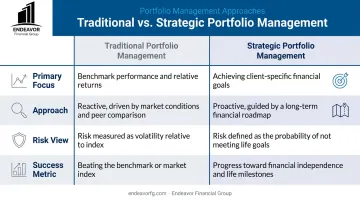
Strategic vs. Traditional Portfolio Management: What's the Difference?
The difference between strategic and traditional portfolio management comes down to one thing: perspective. It’s a shift from a reactive, siloed approach to a proactive, integrated one.
Traditional portfolio management often focuses on asset allocation and benchmarking individual investments against market indices like the S&P 500. The primary goal is to maximize returns for a given level of risk within each separate account. It's about "doing things right" in each investment silo.
Strategic portfolio management, on the other hand, starts with your end goal and works backward. It's about "doing the right things" across all your assets to achieve a specific life outcome. The performance of the total portfolio in relation to your goal is far more important than the performance of any single asset against a market benchmark.
A simple analogy illustrates the difference: Traditional management is like ensuring each ship in a fleet is in top mechanical condition. Strategic management is like being the admiral who directs the entire fleet toward a specific destination, even if it means sacrificing the speed of one ship for the overall success of the mission.
| Feature | Traditional Portfolio Management | Strategic Portfolio Management |
|---|---|---|
| Primary Focus | Beating market benchmarks (e.g., S&P 500) | Achieving specific life goals (e.g., retirement) |
| Approach | Reactive, focused on individual asset performance | Proactive, focused on total portfolio outcome |
| Risk View | Measured by volatility within each account | Measured by the probability of failing to meet a goal |
| Success Metric | "Did my stocks outperform the market?" | "Am I on track to retire on my target date?" |
The 5-Step Process for Implementing Strategic Portfolio Management
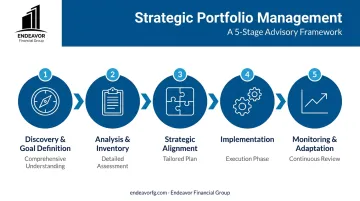
Turning theory into action requires a structured process. At Endeavor Financial Group, we guide our clients through a comprehensive process to build and maintain their strategic roadmap, ensuring every part of their financial life works in concert.
Step 1: Discovery & Strategic Goal Definition
This foundational step sets the direction for your entire financial strategy. Before any decisions are made, you must define clear, measurable, and time-bound strategic objectives. This is the "why" behind your entire portfolio. Vague goals like "becoming wealthy" aren't actionable.
Actionable goals look like this:
- Retire in 15 years with a sustainable income of $120,000 per year in today's dollars.
- Grow my business to a $5 million valuation for a successful sale in the next 10 years.
- Fund 100% of my two children's college education, starting in 8 and 10 years, respectively.
Step 2: Analysis & Portfolio Inventory
Next, you need a complete and accurate picture of your current financial situation. This involves gathering data on all your assets, liabilities, income streams, and expenses.
This inventory should include:
- Retirement accounts (401(k)s, IRAs)
- Brokerage and savings accounts
- Real estate equity
- Business financials, assets, and debts
- Insurance policies and annuities
- Outstanding loans (mortgage, business loans)
Step 3: Strategic Alignment & Planning
With your goals defined and your inventory complete, you can now evaluate how well your current portfolio aligns with your objectives. This is where you identify gaps (e.g., not enough growth assets to meet your retirement timeline) and misalignments (e.g., too much cash sitting idle and losing value to inflation). The output of this step is a concrete action plan—your strategic roadmap.
Step 4: Implementation & Execution
A plan is only as good as its execution. This step involves putting your roadmap into motion. Depending on your situation, this could involve:
- Rebalancing investment portfolios
- Adjusting your savings and investment rates
- Launching a new business initiative to drive value
- Establishing a formal succession plan for your business
- Optimizing your tax strategy
Step 5: Ongoing Monitoring & Adaptation
Strategic Portfolio Management is not a "set it and forget it" activity. Your life changes, markets shift, and your goals may evolve.
It's essential to conduct regular reviews—at least annually or whenever a major life event occurs—to track progress. This allows you to make necessary adjustments to your plan, ensuring you stay on course.
Best Practices for Long-Term Portfolio Success
A successful strategic portfolio is built on discipline and a clear-eyed view of what matters most.
Prioritize Relentlessly
The essence of strategy is making trade-offs. You can't do everything at once. You must consistently choose actions and allocate capital to the initiatives that have the biggest impact on your main goal. This means saying "no" to opportunities that, while potentially good, are not aligned with your primary objective.
Maintain a Long-Term Perspective
Your strategic plan should act as an anchor during periods of market volatility. It's easy to get caught up in short-term noise and make emotional decisions, like panic selling during a downturn. A disciplined, long-term approach helps you avoid these costly behavioral mistakes and stay focused on the horizon.
Integrate Business and Personal Finances
For business owners, this is non-negotiable. Your business is likely your largest asset, but it's also a source of concentrated risk. A unified strategy must consider how business decisions impact your personal wealth and vice-versa.
Failing to do so can be catastrophic. According to the Exit Planning Institute, only 20% to 30% of businesses that go to market actually sell, leaving many owners without a way to harvest the wealth they've built. Integrating your business exit plan with your personal retirement plan is a cornerstone of true SPM and a key area where a comprehensive financial advisor adds significant value.
Frequently Asked Questions
What do strategic portfolio management services do?
These services help individuals and businesses define long-term financial goals, then create and manage a unified plan across all assets and investments. The focus is on ensuring every financial component works together to achieve those primary objectives.
How is strategic portfolio management different from regular financial planning?
While regular financial planning addresses components like budgeting and investing, SPM is a higher-level discipline. It ensures all those components are perfectly aligned and coordinated to serve a single, primary strategic objective for your entire financial life.
Can an individual apply strategic portfolio management to their personal finances?
Absolutely. SPM is a powerful mindset for anyone with multiple financial assets (like a 401k, a home, and savings). It helps ensure all your assets are coordinated to achieve major life goals like a secure and timely retirement.
What are the first steps for a small business owner to implement SPM?
Start by defining a single strategic goal, such as growth for a future sale. Then, inventory all business projects and investments to evaluate how well each supports that primary objective.
How often should a strategic portfolio be reviewed?
A comprehensive review should happen at least annually. You should also revisit your plan whenever a major life or business event occurs, such as a change in income, family status, or significant market shifts.
What's the biggest mistake people make when managing their financial portfolio?
The most common mistake is managing assets in separate silos without a unifying strategy. This approach leads to conflicting actions, inefficient use of capital, and inconsistent progress toward long-term goals.