

The high-income potential of the medical profession comes with a significant tax burden. Without a proactive strategy, taxes can erode your ability to build wealth, pay off debt, and retire comfortably. This guide provides a clear, actionable roadmap for tax planning and retirement strategies specifically for physicians—whether you're an employee, practice owner, or independent contractor.
TL;DR: Key Tax Strategies for Physicians
- Maximize Retirement Accounts: Fully fund your 401(k), 403(b), and 457(b) if employed. Practice owners should use a Solo 401(k) or SEP IRA.
- Use Advanced Plans: High-earners can use Cash Balance Plans to contribute and deduct an additional six figures annually.
- Leverage HSAs: A Health Savings Account offers a triple-tax advantage and can function as a "stealth IRA" for medical costs in retirement.
- Optimize Your Business Structure: Practice owners can use an S-Corp election to reduce self-employment taxes on distributions.
- Integrate Your Financial Team: The most effective strategy involves your financial planner and CPA working together to align tax decisions with long-term goals.
Why Tax Planning is Different (and More Critical) for Physicians
Standard tax advice often falls short for medical professionals. Your financial landscape is unique and requires a specialized approach for several key reasons.
High-Income Brackets
Physicians quickly climb into the highest federal tax brackets. For 2024, a married couple filing jointly enters the 32% bracket at $383,901 and the 35% bracket at $487,451. At these levels, every deduction and tax-deferred contribution has a significant impact on your overall tax bill, making strategic planning essential.
Complex Compensation Structures
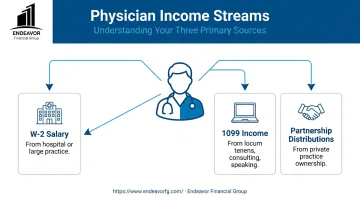
Your income rarely comes from a single, simple source. Many physicians juggle a mix of:
- W-2 Salary: From a hospital or large practice group.
- 1099 Income: From locum tenens work, consulting, speaking engagements, or side gigs.
- Partnership Distributions: From owning a share in a private practice.
Each income stream has different tax implications, requiring a coordinated strategy to manage your liability effectively.
Significant Student Loan Debt
The path to becoming a doctor is expensive. According to the AAMC, the median education debt for medical school graduates in the Class of 2023 was $200,000. Managing this substantial debt influences your cash flow, investment decisions, and overall financial strategy, adding another layer of complexity to your tax planning.
Core Retirement Strategies to Lower Your Taxable Income
Your most powerful tool for reducing taxable income is maximizing tax-advantaged retirement accounts. The right strategy depends on your employment structure.
For Employed (W-2) Physicians: Your First Line of Defense
If you work for a hospital or a large medical group, your employer-sponsored plans are the foundation of your retirement savings.
- 401(k) or 403(b) Plans: Your primary goal should be to max out your pre-tax contributions each year. For 2024, the employee contribution limit is $23,000. Every dollar you contribute reduces your taxable income for the year.
- 457(b) Plans: Often available at non-profit hospitals and government institutions, these plans are a huge advantage. A 457(b) allows you to contribute an additional $23,000 (for 2024) on top of your 401(k) or 403(b) contributions, effectively doubling your tax-deferred savings potential.
For Practice Owners & Independent Contractors
If you're self-employed or run your own practice, you have access to even more powerful retirement vehicles.
- Solo 401(k): This is often the best choice for independent physicians. It allows you to contribute as both the "employee" (up to $23,000 in 2024) and the "employer." As the employer, you can contribute up to 25% of your compensation. The total combined contributions for 2024 cannot exceed $69,000.
- SEP IRA: A Simplified Employee Pension (SEP) IRA is another option. It's easy to set up, but you can only make contributions as the "employer" (up to 25% of compensation, not to exceed $69,000 for 2024). This often results in a lower maximum contribution than a Solo 401(k) for high earners.
Advanced Strategies for Maximizing Savings
Once you've maxed out the standard accounts, it's time to explore advanced strategies to accelerate your savings and tax deductions.
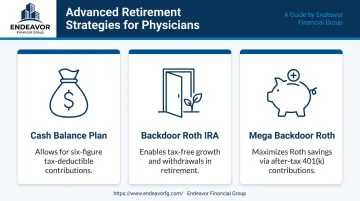
- Cash Balance Plan: This is a powerful tool for high-income practice owners. A cash balance plan is a type of defined benefit plan that allows for massive tax-deductible contributions, often exceeding six figures annually. Contribution limits are based on age and income, allowing older physicians to save aggressively for retirement.
- Backdoor Roth IRA: Most physicians earn too much to contribute directly to a Roth IRA. The Backdoor Roth IRA is a process where you make a non-deductible contribution to a Traditional IRA and then immediately convert it to a Roth IRA. This allows your money to grow and be withdrawn tax-free in retirement.
- Mega Backdoor Roth: If your 401(k) plan allows for after-tax contributions, you may be able to use the Mega Backdoor Roth strategy. This involves making non-Roth after-tax contributions to your 401(k) and then converting them to a Roth IRA or a Roth 401(k), creating another stream of tax-free retirement income.
Navigating these advanced options requires careful planning to ensure compliance and alignment with your overall financial goals.
Tax-Efficient Tools Beyond Retirement Accounts
A comprehensive tax strategy goes beyond dedicated retirement plans. Leveraging other tax-advantaged accounts can further reduce your tax burden and boost your savings.
The Health Savings Account (HSA): A Triple-Tax-Advantaged Powerhouse
If you have a high-deductible health plan (HDHP), an HSA is one of the most powerful savings tools available. It offers three distinct tax benefits:
- Tax-Deductible Contributions: Money you put in is tax-deductible, lowering your current income.
- Tax-Free Growth: The funds can be invested and grow completely tax-free.
- Tax-Free Withdrawals: You can withdraw money tax-free for qualified medical expenses at any time.
For 2026, you can contribute up to $4,400 for self-only coverage or $8,750 for family coverage.
To maximize its growth, consider paying for current medical bills out-of-pocket. This approach treats your HSA like a "stealth IRA"—an investment account that can grow for decades to cover healthcare costs tax-free in retirement.
Other Considerations: 529 Plans and Tax-Loss Harvesting
- 529 College Savings Plans: While contributions aren't deductible at the federal level, more than 30 states offer a state income tax deduction or credit. This makes 529 plans a great way to save for education while also getting a state tax break.
- Tax-Loss Harvesting: In your taxable brokerage accounts, you can sell investments at a loss to offset capital gains from winning investments. If your losses exceed your gains, you can deduct up to $3,000 of excess loss against your ordinary income each year.
Advanced Tax Planning for Practice Owners & 1099 Income
For physicians who operate as a business, strategic tax planning is crucial for managing cash flow and maximizing profitability.
Entity Selection: The S-Corporation Advantage
Electing S-Corp status can significantly reduce your self-employment tax liability. As an S-Corp, you split your income into two parts:
- A "Reasonable Salary": This is what you pay yourself as an employee. It's subject to Social Security and Medicare taxes (FICA).
- Distributions: Any remaining profit is paid out as a distribution, which is not subject to FICA taxes.
For example, if your practice nets $400,000 and you pay yourself a reasonable salary of $200,000, you only pay self-employment taxes on that salary. The remaining $200,000 is taken as a distribution, saving you thousands in taxes.
Maximizing Business Deductions
Don't leave money on the table. Be sure to deduct all legitimate business expenses related to your practice or 1099 income, including:
- Continuing Medical Education (CME) costs
- Licensing fees and board certifications
- Malpractice insurance premiums
- Medical journal subscriptions and professional memberships
- Home office expenses (if you meet the requirements)
- Business-related travel and auto expenses
Strategic Investments in Your Practice
Purchasing necessary medical equipment or real estate can create significant tax deductions through depreciation.
Section 179 Deduction
This tax code provision allows you to deduct the full purchase price of qualifying equipment in the year it's placed in service. For 2024, the deduction limit is $1,220,000. Tax laws change, so it's critical to verify the current limits.
Bonus Depreciation
This allows you to deduct a large percentage of an asset's cost upfront. The bonus depreciation rate for 2024 is 60%, though proposals to restore it to 100% are under legislative consideration. It can often be used with the Section 179 deduction.
Cost Segregation Studies
If you own your medical office building, a cost segregation study can accelerate depreciation. This engineering-based analysis identifies parts of your building that can be depreciated over shorter periods (5, 7, or 15 years) instead of the standard 39, creating a large upfront tax deduction.
The Non-Negotiable: Integrating Your Tax and Financial Plan
The biggest mistake high-income professionals make is managing their finances in silos, where different advisors work in isolation:
- Your CPA handles taxes.
- Your financial advisor manages investments.
- Your attorney handles estate planning.
This fragmented approach means no one is looking at the complete picture, which leads to missed opportunities and costly errors.
Effective wealth management requires a collaborative team where your financial planner works directly with your CPA. This ensures tax decisions aren't just about minimizing this year's bill but are aligned with your long-term goals for retirement, debt repayment, and wealth accumulation.
At Endeavor Financial Group, this holistic philosophy is at the core of what we do. We act as the central point of contact, ensuring tax advice aligns with your investment strategy and retirement goals.
Our comprehensive approach provides physicians with a clear roadmap, turning tax planning from a once-a-year event into an integrated part of your ongoing financial strategy.
Frequently Asked Questions
What is the best retirement plan for a high-income physician?
It depends on your employment status. For W-2 physicians, it's a 401(k)/403(b) often paired with a 457(b). For practice owners, a Solo 401(k) combined with a Cash Balance Plan typically allows for the largest tax-deferred contributions.
Can an employed (W-2) physician still deduct business expenses?
Generally, no. Unreimbursed employee expenses are no longer deductible at the federal level due to tax law changes. However, if you have any 1099 side income, you can and should deduct all related business expenses against that income.
Is forming an S-Corp always the best choice for a medical practice?
An S-Corp can reduce self-employment tax, but it isn't a universal solution. It adds administrative complexity and requires setting a "reasonable salary," so a professional evaluation is crucial for your specific practice.
How can physicians use an HSA as a retirement savings tool?
By paying for current medical expenses out-of-pocket and investing the HSA funds, the account can grow tax-free for decades. It then acts as a dedicated, tax-free fund to cover healthcare costs in retirement.
What are the biggest tax mistakes physicians make?
The most common errors include failing to maximize all available retirement accounts, missing deductions related to 1099 income, and not coordinating strategies between their financial advisor and CPA, leading to conflicting advice.
When should I involve a financial planner in my tax strategy?
You should involve a planner as early as possible. A planner ensures your tax decisions support long-term goals like retirement and wealth accumulation, rather than just focusing on short-term tax reduction.