The challenge isn’t a lack of choice; it’s finding the specific ETFs that align with long-term goals like wealth preservation, steady growth, and reliable income. With global ETF assets reaching a record $21.91 trillion, it's clear they are a dominant force. This guide cuts through the noise to help you understand how to select the best ETFs and build them into a cohesive strategy that works for you.
TL;DR
- ETFs are cost-effective, transparent, and flexible tools for building a diversified investment portfolio.
- The best ETFs are chosen based on low expense ratios, high liquidity, minimal tracking error, and alignment with specific goals.
- This guide covers top ETFs in four key categories: Core US Equity, International Equity, Fixed Income, and Alternative Assets.
- A successful strategy involves more than just picking good ETFs; it requires strategic allocation and regular rebalancing.
- For complex goals, partnering with a financial planner can help translate ETF selection into a comprehensive wealth management strategy.
What Are ETFs and Why Are They Key for Portfolio Management?
An Exchange-Traded Fund (ETF) is a basket of securities—like stocks, bonds, or commodities—that trades on an exchange just like a single stock. This allows you to own a small piece of hundreds or thousands of assets in one transaction, a structure that offers powerful advantages for managing your portfolio.
Key benefits of using ETFs include:
- Achieve instant diversification. An ETF spreads your investment across many assets, reducing the risk tied to any single company's performance.
- Keep costs low. ETFs are known for low management fees, or "expense ratios." The average for index equity ETFs was just 0.14% in 2023, far less than the 0.68% for actively managed mutual funds.
- Gain transparency and flexibility. You can see an ETF's exact holdings daily and trade it any time the market is open, offering more control than traditional mutual funds.
Beyond these core benefits, ETFs are also highly tax-efficient. Thanks to their unique creation and redemption process, they generate fewer taxable capital gains distributions. From 2020 to 2024, only 2% of index ETFs paid capital gains distributions, compared to 51% of active mutual funds.
Our Criteria for Selecting the Top ETFs
Our selection process ignores short-term trends and hype. Instead, it’s grounded in the objective metrics crucial for long-term investors aiming for sustainable growth and stability.
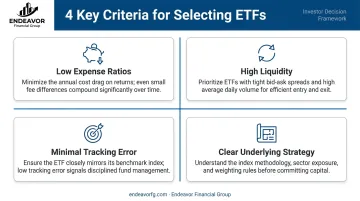
Here are the key factors we considered for every recommendation:
- Low Expense Ratios: We prioritized ETFs with minimal annual fees. Lower costs directly translate to higher long-term returns by keeping more of your capital working for you.
- High Liquidity: Each fund has high trading volume and assets under management (AUM), ensuring you can buy or sell shares efficiently without price disruption.
- Minimal Tracking Error: We require an ETF’s performance to closely match its underlying benchmark, which signals efficient and predictable management.
- Clear Underlying Strategy: Our recommendations track well-established, broad-based indexes, providing a reliable and understandable investment foundation.
The Best ETFs for a Diversified Portfolio (Categorized)
A strong portfolio is built with a mix of different asset classes. The following ETFs are excellent building blocks, each serving a distinct purpose. Think of them as the essential ingredients for creating a portfolio tailored to your financial goals.
Category 1: Core US Equity for Stability and Growth
This category is the foundation of most portfolios. These ETFs provide broad exposure to the U.S. stock market, which has historically been a primary driver of long-term growth.
Vanguard S&P 500 ETF (VOO)
VOO tracks the S&P 500 index, giving you a stake in 500 of the largest and most established companies in the U.S. Its combination of an extremely low expense ratio and high liquidity makes it an ideal core holding for almost any investor.
| Key Specs | Details |
|---|---|
| Ticker | VOO |
| Expense Ratio | 0.03% |
| Primary Exposure | Large-Cap US Stocks |
Schwab U.S. Broad Market ETF (SCHB)
For even greater diversification, SCHB tracks an index that includes large, mid, and small-cap U.S. stocks. This comprehensive exposure captures the performance of the entire U.S. stock market in a single, low-cost fund.
| Key Specs | Details |
|---|---|
| Ticker | SCHB |
| Expense Ratio | 0.03% |
| Primary Exposure | Total US Stock Market |
Category 2: International Equity for Global Diversification
Investing only in your home country can limit your growth opportunities. International ETFs help you tap into economic growth around the world and reduce the risk of a downturn in any single market.
Vanguard Total International Stock ETF (VXUS)
VXUS is a simple, one-stop solution for global diversification. It provides exposure to thousands of stocks in both developed and emerging markets outside of the United States, all within a single, low-cost ETF.
| Key Specs | Details |
|---|---|
| Ticker | VXUS |
| Expense Ratio | 0.05% |
| Primary Exposure | Global ex-US Equities |
iShares Core MSCI EAFE ETF (IEFA)
For investors who prefer to control their exposure to emerging markets, IEFA is an excellent choice. It focuses specifically on developed markets in Europe, Australia, and Asia, offering a targeted way to invest internationally while managing risk.
| Key Specs | Details |
|---|---|
| Ticker | IEFA |
| Expense Ratio | 0.07% |
| Primary Exposure | Developed Markets ex-US Equities |
| Key Specs | Details |
|---|---|
| Ticker | VNQ |
| Expense Ratio | 0.13% |
| Primary Exposure | US Real Estate Investment Trusts |
Building Your Strategic ETF Portfolio: From Selection to Management
Owning a list of great ETFs is a good start, but it's not a complete strategy. The real value comes from combining these tools into a cohesive plan that aligns with your personal financial journey.
Determine Your Asset Allocation
Asset allocation is the process of deciding what percentage of your portfolio to put into different asset classes, primarily stocks and bonds. This is the single most important decision you'll make. Your ideal mix depends on your risk tolerance, time horizon, and financial goals. For example, a pre-retiree might aim for a balanced 60% stock / 40% bond portfolio to balance growth with capital preservation.
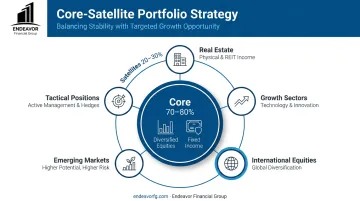
The Core-Satellite Approach
This is a popular and effective strategy for structuring a portfolio.
- The Core (70-80%): This portion is built with broad-market, low-cost index ETFs like VOO (US Stocks) and BND (US Bonds). The goal of the core is to capture market returns reliably and cheaply.
- The Satellites (20-30%): These are smaller, more targeted positions used to enhance returns or add diversification. This is where you might include ETFs like VNQ (Real Estate) or a fund focused on a specific sector you believe has high growth potential.
The Importance of Rebalancing
Over time, the performance of your investments will cause your portfolio to drift from its target allocation. If stocks have a great year, for example, they might grow to represent 70% of your portfolio instead of your intended 60%.
Rebalancing brings your portfolio back in line by periodically selling some winners and buying more underperformers. This disciplined process is a practical way to "buy low and sell high."
When a DIY Approach Isn't Enough
This guide provides a strong foundation, but applying these principles to complex financial situations requires professional guidance. For business owners managing uneven cash flow or pre-retirees figuring out how to turn a 401(k) into a steady paycheck, the stakes are too high for guesswork.
At Endeavor Financial Group, we use tools like ETFs within a comprehensive financial plan, not just as standalone investments. Our structured process helps build a personalized roadmap toward your specific goals.
As fee-only fiduciaries, our advice is always in your best interest. If you're a pre-retiree or business owner in Indiana looking for strategic wealth planning, contact us for a consultation.
Frequently Asked Questions
What is the 7% rule in ETF?
The '7% rule' isn't a standard investing principle but refers to a market-wide circuit breaker. If the S&P 500 drops 7%, trading can be temporarily halted to prevent panic selling.
What is the difference between an ETF and a mutual fund?
The main difference is how they trade. ETFs trade like stocks throughout the day at changing prices, while mutual funds are priced only once at the end of the day. ETFs also generally offer greater tax efficiency and lower expense ratios.
How many ETFs should I have in a diversified portfolio?
You can achieve excellent diversification with just 3 to 5 core ETFs covering US stocks, international stocks, and bonds. Owning too many often creates unnecessary complexity and overlapping holdings without adding significant benefits.
Are ETFs a good investment for beginners?
Yes, broad-market index ETFs are an excellent choice for beginners. They offer instant diversification, low costs, and simplicity, removing the pressure of trying to pick individual winning stocks.