

Executives and entrepreneurs operate in a financial world far more complex than the one covered by standard financial advice. You're not just managing a salary and a 401(k); you're dealing with concentrated stock, unpredictable cash flow, intricate tax scenarios, and the often-blurry line between personal and business assets.
This guide provides a complete framework for building a strategic wealth plan tailored to your specific challenges and opportunities. It’s a roadmap to convert your professional success into durable financial freedom.
Key Takeaways
- Wealth planning for executives and entrepreneurs requires a specialized approach due to complex compensation, concentrated assets, and business-related risks.
- Key challenges include managing equity compensation (stock options, RSUs), navigating irregular cash flow, minimizing complex tax burdens, and planning for a business exit.
- A successful plan involves a structured, multi-step process: discovery, in-depth analysis, strategic implementation, and continuous monitoring.
- Core components include investment management, advanced tax strategy, retirement planning, risk management, and estate planning.
- Avoiding common pitfalls like mixing personal and business finances is critical for translating professional success into personal financial freedom.
What is Wealth Planning for Executives and Entrepreneurs?
Wealth planning for executives and entrepreneurs is a comprehensive process for growing and protecting your wealth. It creates a clear roadmap that translates career achievements into lasting financial independence while aligning with your unique personal and professional goals.
This goes far beyond typical financial planning. While standard advice might focus on budgeting and retirement accounts, specialized wealth planning addresses sophisticated issues that are unique to your situation. This includes:
- Monetizing equity compensation in a tax-efficient way.
- Managing and diversifying concentrated stock positions.
- Structuring your business for tax efficiency and a future exit.
- Integrating advanced estate and asset protection strategies.
The goal is to build a cohesive financial life where your business, investments, and personal goals all work in harmony.
Why Specialized Wealth Planning is Non-Negotiable
As an executive or entrepreneur, your financial life doesn't fit a simple mold. The factors driving your success also create unique challenges that demand a sophisticated, proactive approach.
The Executive's Challenge: Managing Concentrated Wealth
For many executives, a significant portion of their net worth is tied to their employer. In 2024, stock awards made up approximately 73% of median total compensation for the highest-paid CEOs, according to a study by Equilar. This creates a massive concentration risk—the danger of amplified losses if that single stock performs poorly.
This wealth is often held in several forms of equity, each with different tax implications:
- Incentive Stock Options (ISOs): Favorable tax treatment but can trigger the Alternative Minimum Tax (AMT).
- Non-Qualified Stock Options (NQSOs): The spread at exercise is taxed as ordinary income.
- Restricted Stock Units (RSUs): Taxed as income when they vest, creating a potentially large tax bill.
A specialized plan helps you create strategies to diversify this wealth in a tax-efficient manner, using tools like a 10b5-1 plan to schedule sales or charitable strategies to offset gains.
The Entrepreneur's Dilemma: Irregular Cash Flow and Business Integration
Entrepreneurs thrive on agility, but this often leads to unpredictable income streams. The business bank account can easily become a personal slush fund, blurring the lines and putting personal assets at risk. This is a critical issue, as industry data from SCORE shows that 82% of small businesses fail due to poor cash flow management.
Much of an entrepreneur's wealth is also illiquid, tied directly to the business itself. Planning for a major liquidity event—like a sale, merger, or IPO—needs to start years in advance to maximize the financial outcome and minimize the tax impact.
The Universal Hurdles: Tax Complexity and Asset Protection
High incomes, capital gains from stock sales, and business profits create significant tax burdens. Proactive, advanced tax planning isn't just about filing your return correctly; it's about making strategic decisions year-round to reduce your liability. This means looking ahead at how exercising options or selling a business will impact your tax bracket, not after the fact.
You also need to protect your personal assets from business liabilities and other risks. This involves establishing the right legal structures and ensuring you have the proper insurance in place to safeguard what you've built.
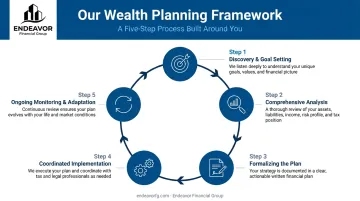
The 5-Step Wealth Planning Framework
Navigating this complexity requires a disciplined, structured process. A proven framework helps ensure a comprehensive approach and that your plan is built on a solid foundation. At Endeavor Financial Group, we use a five-step process to create a clear roadmap toward financial freedom.
Discovery and Goal Setting This initial step goes beyond the numbers to define what financial success means to you. We explore your personal and professional goals, core values, risk tolerance, and family dynamics. For a business owner, this is where we explore how your personal and business finances are intertwined and what your long-term vision is for both.
Comprehensive Analysis and Strategy Development Next, we gather all your financial data—investment statements, business financials, tax returns, insurance policies, and estate documents. This creates a comprehensive overview of your current situation. We then perform a financial "stress test," running scenarios to identify potential gaps, risks, and opportunities that you might not see on your own.
Formalizing the Plan Based on our analysis, we present a written roadmap. This document contains specific, actionable recommendations for every area of your financial life. For an executive, this might outline a multi-year strategy for exercising stock options. For an entrepreneur, it could detail steps to prepare the business for a future sale.
Coordinated Implementation In this phase, we coordinate implementation with your entire financial team. We work directly with your CPA, attorney, and other trusted professionals to put the plan into action. This alignment ensures your tax, legal, and investment strategies work together, preventing conflicting advice and missed opportunities.
Ongoing Monitoring and Adaptation Your life, the markets, and tax laws constantly change, so wealth planning is an ongoing process. This final step involves regular reviews to track progress and make adjustments. Whether you get a promotion, hit a business milestone, or have a family change, your plan is adapted to evolve with you.
Key Components of a Comprehensive Wealth Plan
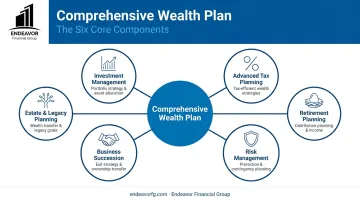
A comprehensive wealth plan is more than just an investment portfolio; it integrates every aspect of your financial life.
Investment Management and Diversification
This goes beyond a simple 60/40 portfolio. Key strategies include:
- Systematically diversifying concentrated stock positions to reduce single-asset risk.
- Using tax-loss harvesting to sell investments at a loss, offsetting capital gains and lowering your tax liability.
- Incorporating alternative investments like real estate or private equity for broader diversification.
Advanced Tax Planning
This involves proactive strategy rather than reactive tax preparation. It involves:
- Optimizing stock option exercises: Timing when you exercise options to manage the tax impact, especially the AMT.
- Charitable giving strategies: Using tools like donor-advised funds to offset large capital gains from a stock sale or liquidity event.
- Business structuring: Choosing the right entity (e.g., S-Corp vs. LLC) to maximize tax efficiency.
Retirement & Financial Independence Planning
For executives and entrepreneurs, this requires specialized tools:
- Executive plans: Managing non-qualified deferred compensation (NQDC) plans alongside traditional retirement accounts.
- Business owner plans: Utilizing retirement vehicles like a SEP IRA (which allows contributions of up to 25% of compensation or $69,000 for 2024) or a Solo 401(k) (with a total 2024 contribution limit of $69,000).
Risk Management and Insurance
This component protects you, your family, and your business from the unexpected.
- Personal insurance: Ensuring you have adequate life and disability insurance to protect your income.
- Business continuity: Using key-person insurance to protect the business from the loss of a critical founder or executive.
- Buy-sell agreements: Creating a legally binding agreement, often funded by life insurance, that dictates how a departing partner's or shareholder's stake will be bought out.
Business Succession and Exit Planning
Crucial for entrepreneurs, this involves creating a clear plan for your eventual transition out of the business, whether it's through a sale to a third party, a transfer to family members, or an employee buyout.
Estate and Legacy Planning
This ensures your wealth is transferred efficiently and according to your wishes. The current federal estate tax exemption is historically high ($13.61 million per individual in 2024), but it is scheduled to be cut significantly after 2025.
High-net-worth individuals need advanced strategies to prepare for this change. These strategies often involve using trusts and other legal structures to minimize estate taxes, protect assets from creditors, and provide for future generations or charitable causes.
Common Wealth Planning Pitfalls and How to Avoid Them
Even the most successful professionals can make critical mistakes that jeopardize their long-term financial security. Understanding these common pitfalls is the first step toward avoiding them.
Confusing Business Success with Personal Financial Security
The Pitfall: According to the Exit Planning Institute, 80% to 90% of a business owner's wealth is often tied up in the business. While the company may be thriving, your personal net worth is highly concentrated and illiquid, leaving you vulnerable. The Solution: Systematically diversify your wealth out of the business over time. Treat your business like any other investment in your portfolio and create a plan to convert that equity into liquid, diversified personal assets.
Neglecting Tax Planning Until It's Too Late
The Pitfall: Waiting until you have a major liquidity event or until year-end to think about taxes. By then, your options are limited, and you could face a massive, unexpected tax bill from exercising stock options or selling your company. The Solution: Integrate proactive, year-round tax strategy into every financial decision. A wealth advisor can model the tax consequences of different choices before you make them, helping you plan ahead and minimize your liability.
Lacking a Coordinated Team of Advisors
The Pitfall: Your CPA gives you tax advice, your attorney handles legal documents, and your financial advisor manages investments—but none of them talk to each other. This leads to conflicting advice, missed opportunities, and a fragmented strategy where the pieces don't fit together. The Solution: Your wealth advisor should act as the "quarterback" for your entire financial team. At Endeavor Financial Group, we coordinate with your existing professionals to ensure everyone is working from the same playbook. This creates a single, cohesive strategy where every part of your financial life supports your long-term goals.
Frequently Asked Questions
How is wealth planning for an executive different from that for an entrepreneur?
Executives typically focus on managing complex compensation packages and diversifying large, concentrated positions in company stock. Entrepreneurs, on the other hand, focus on managing irregular cash flow, separating business and personal finances, and planning for an eventual business exit.
At what point should an entrepreneur start separating personal and business finances?
From day one. Opening separate bank accounts and credit cards immediately protects your personal assets from business liabilities, simplifies your accounting, and establishes good financial discipline from the start.
What is the biggest tax mistake executives make with their stock compensation?
Failing to plan for the tax impact of exercising options or vesting RSUs is a common error. This often leads to a surprise Alternative Minimum Tax (AMT) bill or a massive income tax liability that could have been managed with proactive planning.
How do I create an estate plan that protects both my family and my business?
It requires working with an attorney and wealth advisor to create legal structures, such as trusts and buy-sell agreements. These tools ensure business continuity and a smooth transfer of assets to your heirs while minimizing taxes and disruption.
What's the difference between a wealth manager and a standard financial advisor?
A wealth manager offers comprehensive services for complex needs, integrating tax, estate, and business planning. In contrast, a standard financial advisor often focuses more narrowly on specific areas like investments or basic retirement planning.
How often should I review my wealth plan?
Your plan should be formally reviewed at least once a year. It's also critical to revisit it after any major life or business event, such as a promotion, a change in company valuation, or a new addition to your family.