In fact, you're part of a growing group. According to a 2023 report from Hearts & Wallets, there are now 5.5 million U.S. households with over $2 million in investable assets. At this level, you face unique challenges—from sophisticated tax planning to multi-generational wealth transfer—that demand a higher level of expertise. This guide will walk you through how to find a financial advisor who is truly equipped to navigate the opportunities and complexities of your financial situation.
TL;DR: Choosing the Right HNW Advisor
- An advisor for high-net-worth (HNW) individuals offers comprehensive wealth management, not just investment tips.
- Core services include advanced tax planning, sophisticated estate strategies, and integrated risk management.
- Prioritize advisors with a legal fiduciary commitment and advanced credentials like CFP® and CFA®.
- The right fit comes from asking targeted questions about their experience, process, and fee structure.
What Defines a High-Net-Worth Investor with $2M+ in Assets?
The term "High-Net-Worth" (HNW) typically refers to individuals with $1 million or more in liquid, investable assets, according to the Capgemini World Wealth Report. As you move up the scale, you enter the "Very-High-Net-Worth" (VHNW) category, which often starts at $5 million.
An investor with $2 million sits in a critical transition zone. You've moved beyond mass-market financial products, and your decisions now carry much greater weight. The strategies you implement for taxes, estate planning, and investments can define your family's financial legacy.
You're in a distinct group that represents just 4% of U.S. households but controls a staggering 65% of the nation's assets. This concentration of wealth means you require a level of service and strategic thinking that goes far beyond standard financial advice.
Why Standard Financial Advice Falls Short for Affluent Investors
The financial guidance designed for accumulating wealth is fundamentally different from the advice needed to manage it. For many, financial planning focuses on the basics: contributing to a 401(k), funding an IRA, and saving for retirement. Robo-advisors and many traditional planners excel in this area.
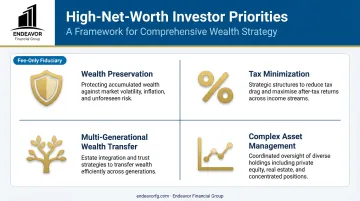
For HNW investors, however, the focus shifts from straightforward accumulation to more complex priorities:
- Wealth Preservation: Protecting assets from market volatility, inflation, and unforeseen risks.
- Tax Minimization: Proactively managing tax liabilities across all aspects of your financial life.
- Multi-Generational Wealth Transfer: Creating a seamless and tax-efficient plan to pass wealth to heirs and charities.
- Complex Asset Management: Managing concentrated stock positions, alternative investments, or business interests.
Overlooking these complexities can be costly. It can lead to significant tax inefficiencies, missed investment opportunities, and a failure to achieve your long-term legacy goals. A generic financial plan simply isn't built to handle the sophisticated coordination required at this level.
Core Services to Expect from a High-Net-Worth Financial Advisor
A true HNW advisor acts as your personal CFO, delivering a suite of integrated services that address your entire financial picture. Here’s what you should expect.
Comprehensive Financial Planning
This is the foundation of wealth management. It's not just about managing investments; it's about creating a unified strategy that integrates every part of your financial life. A strong advisor will have a structured process to ensure all the pieces work together.
At Endeavor Financial Group, we use a five-step process to build and maintain your financial plan:
- Discovery: We start by identifying your goals, priorities, and values.
- Analysis: We take a deep dive into your financial situation to understand the complete picture.
- Strategy Development: We build a detailed, easy-to-follow roadmap with short, intermediate, and long-term goals.
- Implementation: We guide you through each step, from making investment decisions to creating an estate plan.
- Monitoring: We provide ongoing support, reviewing your plan and making adjustments as your life and goals change.
Advanced Tax Planning and Mitigation
Taxes can be one of the biggest drags on wealth creation. A specialized advisor will employ advanced strategies to improve your tax efficiency, such as:
- Tax-Loss Harvesting: Selling investments at a loss to offset gains in other investments, reducing your capital gains tax.
- Asset Location: Strategically placing investments in different types of accounts (taxable, tax-deferred, tax-exempt) to minimize the overall tax bill.
- Proactive Planning: Structuring income, charitable giving, and retirement withdrawals to manage tax brackets and avoid triggers for such as Medicare IRMAA surcharges.
Sophisticated Estate and Legacy Planning
Your advisor should work hand-in-hand with your estate planning attorney to ensure your financial plan and legal documents are perfectly aligned. This includes structuring trusts, planning for efficient wealth transfer to heirs, and establishing vehicles for philanthropic goals, such as donor-advised funds or private foundations.
Integrated Risk Management and Asset Protection
Protecting your wealth is just as important as growing it. An HNW advisor helps you identify potential risks and implement strategies to mitigate them. This often involves reviewing insurance coverage (like umbrella policies) to ensure it's adequate for your net worth and ensuring assets are titled correctly for liability protection.
Specialized Investment Management
While a standard portfolio might consist of mutual funds and ETFs, HNW portfolios often include more complex assets. Your advisor should have experience with:
- Alternative investments (e.g., private equity, private credit, hedge funds)
- Concentrated stock positions from a family business or executive compensation
- Real estate investments
- Tax-advantaged municipal bonds
Coordination with Your Team of Professionals
Your advisor should act as a "financial quarterback," proactively communicating with your CPA, attorneys, and insurance agents. This ensures everyone is working from the same playbook and that your financial, tax, and legal strategies are fully aligned.
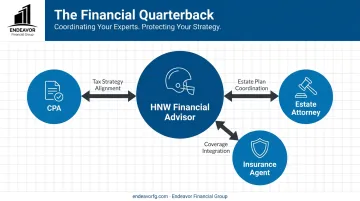
Without this coordination, you can end up with a disjointed plan where one professional's advice unintentionally undermines another's.
Key Credentials and Qualities to Look for in an Advisor
Not all advisors are created equal. When managing significant wealth, it's critical to partner with someone who has the right qualifications, ethics, and experience.
Unwavering Fiduciary Commitment
This is non-negotiable. A fiduciary is legally and ethically bound to act in your best interest at all times. This contrasts sharply with the "suitability" standard, where advice only needs to be appropriate, not necessarily what's best for you.
Always ask if an advisor is a fee-only fiduciary. This means they are compensated only by you, the client, and do not accept commissions for selling products. It's the commitment we make at Endeavor Financial Group to ensure our advice is always unbiased and aligned with your goals.
Advanced Professional Certifications
Look for designations that signify a deep level of expertise and a commitment to the profession. Two of the most respected designations are:
- CFP® (Certified Financial Planner™): This is the gold standard for comprehensive financial planning. CFP® professionals have completed extensive training and testing in investment, retirement, estate, tax, and insurance planning.
- CFA® (Chartered Financial Analyst®): This designation indicates elite expertise in investment analysis and portfolio management. The rigorous CFA® program requires passing three challenging exams and accumulating 4,000 hours of relevant work experience.
Our team at Endeavor Financial Group holds these premier credentials, bringing a high level of proven expertise to our clients.
A Team-Based Approach
Working with a firm that uses a team approach provides a significant advantage. It ensures you have access to multiple specialists and that there's always someone available who understands your financial situation. This provides continuity of service and a broader base of knowledge than relying on a single individual.
Beyond credentials and team structure, an advisor’s direct experience is what translates technical knowledge into real-world results for you.
Demonstrable Experience with Clients Like You
Find an advisor who specializes in working with clients in similar financial situations. Whether you're a business owner planning an exit, an executive managing stock options, or a family focused on intergenerational wealth, you need someone who understands your specific challenges and opportunities.
Essential Questions to Ask Before Hiring a HNW Advisor
Your initial meetings with a potential advisor are a two-way interview. Come prepared with direct questions to ensure they are the right fit for your financial future.
- What percentage of your clients have investable assets in the $2M to $10M range? This confirms they have direct experience managing portfolios similar to yours.
- Are you a fee-only fiduciary? How are you compensated, and what is my total all-in cost? Demand full transparency on all charges, including management (AUM), platform, and administrative fees.
- Can you walk me through your financial planning process? Their answer should reveal a structured, comprehensive process, such as the five-step plan mentioned earlier.
- How do you coordinate with a client's CPA and estate planning attorney? A top-tier advisor will have a proactive process for collaborating with your existing team of professionals.
- What is your investment philosophy, especially regarding tax efficiency and risk management for portfolios of my size? Look for a disciplined, evidence-based approach focused on long-term wealth preservation, not just growth.
Frequently Asked Questions
Is $2 million in investable assets considered high net worth?
Yes. While the technical definition of HNW often starts at $1 million, having $2 million or more places you in a category that requires sophisticated, comprehensive wealth management services that go far beyond standard financial advice.
How many people have $2 million in investable assets?
According to a 2023 Hearts & Wallets report, 5.5 million U.S. households have $2 million or more in investable assets. This group makes up about 4% of all households in the country.
What is the difference between a wealth manager and a financial advisor?
"Wealth manager" typically refers to an advisor specializing in HNW clients with a holistic, comprehensive approach to all aspects of their financial life. "Financial advisor" is a broader term that can include those focused on simpler, product-based solutions.
How are financial advisors for HNW clients compensated?
Most HNW advisors use a fee-only model based on a percentage of assets under management (AUM). According to Kitces Research, the median fee for a $2 million portfolio is around 0.9%, and this percentage typically decreases as assets grow.
What certifications should I look for in an HNW advisor?
Look for the CFP® (Certified Financial Planner™) designation for expertise in comprehensive planning and the CFA® (Chartered Financial Analyst®) charter for deep investment knowledge. These credentials demonstrate a high level of commitment and expertise.