
When one stock makes up more than 10-20% of your portfolio, it's considered a concentrated position. While it may have created your wealth, relying on it to preserve and grow that wealth exposes you to unnecessary risk. The same stock that built your fortune could just as easily jeopardize it.
This guide provides a clear roadmap for managing that risk. We’ll explore proven diversification and hedging strategies, break down the critical tax considerations, and highlight common pitfalls to help you protect what you’ve built.
Key Takeaways
- Holding over 10-20% of your portfolio in one stock creates significant single-company risk.
- Primary solutions involve either diversifying your holdings or using options to hedge your position.
- Managing the capital gains tax burden is a critical factor in your diversification strategy.
- Assess your goals, tax basis, and any restrictions before making any changes.
Why a Concentrated Stock Position is Riskier Than You Think
The stock that got you here might feel like a sure thing, but past performance is never a guarantee of future results. Relying on a single company for your financial security is like having your salary, bonus, and retirement savings all tied to one employer's fate. A single negative event could have an outsized impact on your net worth.
This is known as idiosyncratic risk—the risk inherent to a specific company. It’s completely separate from the market-wide (systematic) risk that affects all companies. Idiosyncratic risk can be triggered by many factors:
- A failed product launch
- Unexpected regulatory changes
- A new, disruptive competitor
- An executive leadership scandal
- An unfavorable legal ruling
These events can cause a sharp, sudden, and sometimes permanent decline in a stock's value. While a diversified portfolio can weather the storm of one company faltering, a concentrated portfolio cannot.
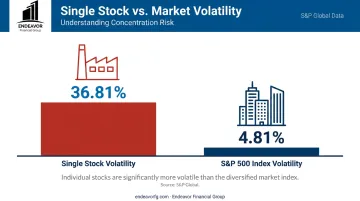
The data confirms that individual stocks are far more volatile than the broader market. The annualized volatility for single stocks in the S&P 500 recently measured 36.81%, while the volatility for the S&P 500 index as a whole was just 4.81%, according to S&P Global.
Furthermore, long-term academic research shows that most individual stocks don't deliver market-beating returns. A landmark study by Hendrik Bessembinder found that since 1926, four out of every seven U.S. common stocks had lifetime returns lower than one-month Treasury bills.
Beyond the numbers, psychological biases often make it difficult to act. Investors can feel an emotional attachment ("I helped build this company") or a fear of missing out (FOMO) on future gains.
This can lead to inaction at the exact moment when a clear-eyed strategy is needed most.
Key Considerations Before Making a Move
Developing a strategy for a concentrated stock position requires careful planning tailored to your unique circumstances. Before you sell a single share, consider these four key areas.
Clarify Your Financial Goals and Risk Tolerance
First, define what this wealth is for. Are you planning for retirement, funding a child's education, leaving a legacy, or making a major purchase? Your goals will determine your timeline and how much risk you need—or can afford—to take. This process helps you shift from thinking like a company insider to managing a portfolio designed to meet your life's objectives.
Understand Your Tax Situation
Taxes are often the biggest hurdle. When you sell appreciated stock, you will likely owe capital gains tax on the profit. The key is to understand your cost basis—what you originally paid for the shares. The difference between the sale price and your cost basis is your capital gain.
The tax rate depends on how long you held the stock.
- Stock held one year or less is subject to short-term capital gains, taxed at your ordinary income rate (which can be as high as 37%).
- Stock held more than one year qualifies for long-term capital gains, taxed at preferential rates of 0%, 15%, or 20% depending on your income.
A large sale can easily push you into a higher tax bracket, making a well-thought-out tax strategy essential.
Identify Any Restrictions
Company executives, founders, and early employees often face restrictions on when and how they can sell their shares. These can include:
- Company blackout periods, which are windows of time (usually around earnings announcements) when insiders cannot trade.
- Lock-up periods that contractually prevent insiders from selling shares for a set time after an IPO.
- Insider trading rules that prohibit trading based on material, non-public information.
Tools like a 10b5-1 plan are specifically designed to help insiders navigate these rules by setting up a pre-arranged, automated selling schedule.
Get Professional Guidance
Managing the interplay between your goals, tax implications, and legal restrictions requires a holistic view. A financial planning team can provide this perspective, which is critical for success. At Endeavor Financial Group, we specialize in creating comprehensive plans that align a concentrated stock strategy with your broader financial life.
Core Diversification Strategies: How to Systematically Reduce Your Holding
The most fundamental strategy for reducing concentration risk is diversification—methodically converting a portion of your single-stock holding into a broader range of assets. This insulates your portfolio from the fate of any one company.
Outright or Gradual Sale
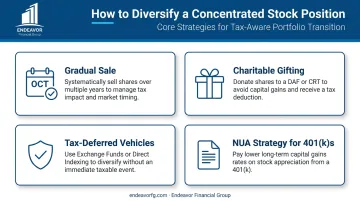
The most direct approach is to sell the shares. However, selling a large position all at once can trigger a massive tax bill. A more common strategy is a gradual or staged selling plan spread over several months or years. This allows you to:
- Manage the tax impact by spreading the capital gains across multiple tax years.
- Avoid selling into a temporary market downturn.
- Systematically reduce your position without making an "all or nothing" bet.
You can also use tax-loss harvesting—selling other investments at a loss—to offset the gains from your concentrated stock sales.
Gifting and Charitable Strategies
If you have philanthropic goals, gifting appreciated stock can be one of the most tax-efficient ways to diversify.
Donor-Advised Funds (DAFs) are a popular option. You can donate shares directly to a DAF, receive a current-year tax deduction for the stock's full market value, and avoid capital gains tax. The DAF sells the stock tax-free, and you can then recommend grants to your favorite charities over time.
Charitable Remainder Trusts (CRTs) offer another approach. You transfer appreciated stock to an irrevocable trust, which sells it tax-free and invests the proceeds. The trust provides you with an income stream for a set period, with the remaining assets going to your chosen charity.
Tax-Deferred Diversification Vehicles
For accredited investors, certain vehicles allow for diversification without an immediate taxable event.
Exchange Funds, also known as swap funds, let you contribute your stock into a pool with other investors who have concentrated positions. In return, you receive a share of a new, diversified portfolio. This is not a taxable event but often requires keeping your money in the fund for at least seven years.
Direct Indexing involves building a customized portfolio of individual stocks around your concentrated position to mimic a broad index. You can then gradually sell shares of your concentrated stock and use tax-loss harvesting from the other holdings to offset gains.
Net Unrealized Appreciation (NUA) for Company Stock in a 401(k)
This is a powerful but complex strategy for employees with highly appreciated company stock in their 401(k). Normally, 401(k) distributions are taxed as ordinary income.
The NUA rule allows you to distribute company stock "in-kind" to a taxable brokerage account. You pay ordinary income tax only on the stock's cost basis, while the appreciation (the NUA) is taxed at lower long-term capital gains rates when you eventually sell it.
Hedging Strategies: How to Protect Value Without Selling
What if you're legally restricted from selling or remain bullish on the company's long-term prospects but still want to protect against a major downturn? Hedging strategies allow you to manage downside risk while retaining ownership of the stock.
Using Options to Create a Safety Net
- Buy protective puts to act as insurance. A put option gives you the right to sell shares at a set "strike price," limiting your losses while letting you keep any upside potential (minus the option's cost).
- Sell covered calls to generate income. You sell someone the right to buy your shares at a higher strike price, and you receive a cash payment (premium). This caps your gains but provides immediate income.
Equity Collars
A collar combines the two strategies above: buying a protective put to set a floor price and selling a covered call to set a ceiling. This effectively locks your stock's value into a defined range.
Often, the premium received from selling the call can offset the cost of buying the put, creating a low-cost or "cashless" hedge. The trade-off is limiting potential gains in exchange for downside protection.
Prepaid Variable Forward Contracts
This sophisticated transaction is for investors who need immediate liquidity. You contract with an investment bank to deliver a variable number of shares at a future date, typically three to five years out.
In return, you receive a large cash advance—often 75-90% of the stock's current value. This gives you cash to diversify immediately while deferring taxes until the contract settles.
Common Mistakes and Your Path Forward
Managing a concentrated stock position is a critical step in preserving wealth. Unfortunately, many investors fall into common traps.
- Procrastination or "Analysis Paralysis": Overwhelmed by the options and afraid of making the wrong move, many investors do nothing, leaving their wealth exposed to unnecessary risk.
- The "All or Nothing" Approach: Believing the only choices are to sell everything or hold everything. A gradual, phased approach is almost always a better solution.
- Ignoring the Tax Impact: Selling a large position without a plan to manage the capital gains can result in a massive and unexpected tax bill, significantly reducing your net proceeds.
The right strategy requires a careful balance of your financial goals, tax efficiency, and risk management. A clear path forward begins with a personalized plan that avoids these common pitfalls.
At Endeavor Financial Group, our five-step structured process—from discovery and analysis to implementation and ongoing monitoring—is designed to provide that actionable roadmap. We help you cut through the complexity and move forward with confidence.
Frequently Asked Questions
How to manage a concentrated stock position?
Effective management starts with assessing your goals and risk tolerance. Key strategies include gradual selling, charitable gifting, or using hedging instruments like options or collars to protect value while managing tax implications.
What is the 7% rule in stocks?
The "7% rule" is a general guideline suggesting an investor should not have more than 7% of their portfolio in a single stock. However, financial professionals often cite a broader range, flagging positions that exceed 5% to 20% of a portfolio as concentrated.
What are the main tax implications of selling a concentrated stock position?
The main tax is capital gains tax on your profit. The rate is higher for short-term gains (stock held under a year) and lower for long-term gains (stock held over a year), which are taxed at more favorable rates.
Can I hedge my company stock if I am an executive?
Yes, but restrictions often apply. Company policy may prohibit certain strategies, like buying protective puts, while allowing others, such as cashless collars. Always consult your company's trading policy and legal counsel before acting.
What is a 10b5-1 plan and why is it useful?
A 10b5-1 plan is a pre-arranged trading plan that allows company insiders to sell a predetermined number of shares at a predetermined time. Following the plan's strict rules helps protect insiders from accusations of trading on non-public information.