

This is where business succession planning comes in. It's the strategic process of preparing for the transfer of your dental practice's ownership and management to ensure its continued success. For dentists, this process is uniquely critical. It protects patient continuity, provides stability for your loyal staff, and is the key to converting your practice's value into a comfortable retirement. This guide provides a clear roadmap to creating a comprehensive succession plan that secures your legacy.
Key Takeaways
- Protects your practice's value and legacy during a leadership transition.
- Essential for dentists due to unique licensing, patient, and retirement factors.
- Follows a five-stage process from defining goals to final implementation.
- Your timeline, financial needs, and choice of successor define the strategy.
What Is Business Succession Planning for a Dental Practice?
Business succession planning is a comprehensive, documented strategy for transitioning a dental practice's leadership, ownership, and operations. It’s a roadmap for a smooth transfer that aligns with your personal and financial goals for both a planned retirement and unexpected events.
This goes far beyond a simple retirement plan. While retirement planning focuses on your personal finances, a succession plan ensures the health and continuity of the business itself.
It’s the mechanism that converts the value you’ve built in your practice into the funds needed for your retirement.
Why Succession Planning is Uniquely Critical for Dental Practices
While every business owner needs an exit strategy, dentists face a unique set of challenges that make succession planning an absolute necessity. Overlooking these factors can lead to a financial and operational disaster.
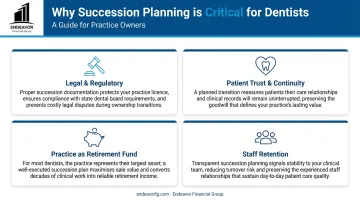
Legal and Regulatory Hurdles
In most states, only a licensed dentist can legally own a dental practice. This rule, known as the corporate practice of dentistry doctrine, is designed to ensure clinical decisions remain with licensed professionals.
However, this creates a massive problem if an owner dies or becomes disabled without a plan. The family cannot legally own the practice, often forcing a fire sale at a fraction of its true value and destroying wealth that took a lifetime to build.
Preserving Patient Trust and Continuity
Dentistry is a relationship-based profession. Patients trust you. A sudden or poorly managed transition can shatter that trust, causing patients to leave and eroding the practice's goodwill. A well-executed plan ensures a seamless handover of care that retains the patient base and preserves its value.
Your Practice is Your Retirement Fund
For many dentists, their practice is their single largest and most illiquid asset. It represents a significant portion of their net worth, but its value is locked up in equipment, patient records, and goodwill. A succession plan is the key to unlocking that value and converting it into the liquid capital needed for retirement. Without a plan, you risk not being able to sell the practice for what it's worth, or at all.
Retaining Your All-Star Staff
Your team—from the hygienists to the office manager—is the engine of your practice. An uncertain future creates anxiety and can lead to key employees looking for more stable opportunities. A clear succession plan provides security and a vision for the future, which is crucial for retaining your team during a transition.
The need for planning is more urgent than ever. According to the American Dental Association, 34.2% of all active dentists in the U.S. were over the age of 55 in 2024, signaling a massive wave of upcoming retirements. Those with a plan will be in the best position to capitalize on their hard work.
How the Succession Planning Process Works: A 5-Step Roadmap
Creating a successful succession plan is a structured process. By breaking it down into manageable steps, you can move from uncertainty to a clear, actionable strategy.
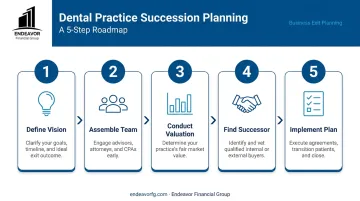
Step 1: Define Your Vision and Personal Financial Goals
Before you can plan your exit, you need to know where you're going. This first step is about introspection. You must decide on your ideal future, both personally and professionally.
Start by asking yourself some critical questions:
- What is my ideal exit timeline? Do I want to be out in two years, five years, or ten?
- What does my ideal exit look like? Do I want to sell the practice and walk away completely? Or would I prefer to phase out gradually, mentoring an associate who takes over?
- Who is my ideal successor? Is it a family member, a current associate, or an external buyer?
- How much income will I need from the sale? This is the most important question. You need to know the number that will fund your desired retirement lifestyle.
Step 2: Assemble Your Professional Advisory Team
Succession planning is too complex to handle alone. As the practice owner, you'll lead a team of experts. Assembling the right team of experts is essential to navigate the financial, legal, and tax complexities.
Your core team should include:
- A Financial Advisor (CFP®/CFA®): This expert typically coordinates the entire strategy. They work to align the practice sale with your personal financial plan, ensuring the proceeds can successfully fund your retirement and estate goals.
- An Attorney: You need a lawyer who specializes in dental practice transitions. They will draft critical legal documents like buy-sell agreements and purchase agreements.
- A Certified Public Accountant (CPA): Your CPA will provide guidance on tax implications, helping structure the sale to minimize your tax burden.
- A Practice Valuation Specialist: This expert provides an objective, defensible valuation of your practice, which forms the foundation of any sale negotiation.
Step 3: Conduct a Comprehensive Practice Valuation
To get the right price for your practice, you first need to understand its objective value. A formal, objective valuation is non-negotiable. Valuation specialists typically use a combination of approaches:
- Market-Based: Compares your practice to similar practices that have recently sold.
- Income-Based: Analyzes your practice's cash flow and profitability to determine its value as an investment.
- Asset-Based: Calculates the value of your tangible assets, like equipment and real estate.
Key factors that drive your practice's value include tangible assets, but more importantly, intangible assets like goodwill, patient records, staff quality, and consistent revenue streams.
Step 4: Identify a Successor and Structure the Transition
With a clear valuation in hand, you can focus on finding the right successor and structuring the deal. There are two primary paths:
- Internal Successor: This could be an associate, partner, or family member. The main advantage is that they already know the practice, staff, and patients. However, it requires years of grooming and planning.
- External Successor: This could be another dentist or, increasingly, a Dental Service Organization (DSO). An external sale can be faster but requires more effort to ensure a good cultural fit. The rise of DSOs is a significant trend; according to ADA data, DSO affiliation among U.S. dentists grew to 13.8% in 2023.
Once a successor is identified, your team will help structure the legal and financial components, including the buy-sell agreement, sale price, payment terms (lump sum vs. installment sale), and tax strategies.
Step 5: Create a Communication and Implementation Plan
The final step is to document the plan and map out how and when you will communicate it to key stakeholders. A poorly timed announcement can cause chaos. Your plan should detail:
- Who to tell: Partners, key staff, and eventually, all employees and patients.
- What to tell: The core message should be one of stability and continuity.
- When to tell: The timing of each communication is critical to managing morale and retaining trust.
Finally, remember that your succession plan is a living document, not a "set it and forget it" file. Review it annually with your advisory team to ensure it still aligns with your goals and reflects any changes in your practice or the market.
Key Factors That Influence Your Dental Succession Plan
Every dental practice is unique, so your succession plan must be tailored to your specific situation. Addressing a few key factors early on will lead to a much smoother transition.
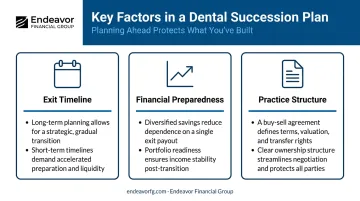
Your Exit Timeline
The amount of time you have before your planned exit is the single biggest factor influencing your options. A longer timeline of 5-10 years provides maximum flexibility. It gives you time to groom an internal successor, make strategic improvements to boost the practice's value, and wait for favorable market conditions.
In contrast, a short timeline of 1-2 years limits your choices. You will likely need to pursue an external sale and will have less leverage in negotiations, which is why starting the planning process early is crucial.
Financial Preparedness and Personal Wealth
Your personal financial situation outside of the practice heavily influences your options. An owner who has diligently saved and invested in a diversified portfolio has more power and flexibility, allowing them to be patient and wait for the right buyer or price.
Conversely, a dentist who is entirely dependent on the sale proceeds for retirement is in a weaker negotiating position. They may be forced to accept a less-than-ideal offer to meet their financial needs.
Practice Structure and Legal Agreements
For partnerships, a well-drafted buy-sell agreement is essential. This legally binding contract pre-defines what happens if a partner exits due to events like death, disability, or retirement.
According to Mariner Wealth Advisors, these agreements are critical for preventing disputes and ensuring business continuity.
Without one, a partner's departure can lead to contentious and expensive legal battles that could cripple the practice.
The Role of Your Financial Advisory Team
A dental practice succession is complex and requires a strategic coordinator—a "quarterback" who can see the entire field. This is the role a comprehensive financial advisory firm plays. A CERTIFIED FINANCIAL PLANNER™ (CFP®) professional or Chartered Financial Analyst® (CFA®) charterholder with experience in business exits can integrate all the moving parts.
At Endeavor Financial Group, we specialize in helping business owners create a seamless transition from running their business to enjoying their retirement. Our role is to ensure your business succession plan is perfectly aligned with your personal financial plan. We coordinate with your attorney and CPA to structure the transition in a way that maximizes your proceeds and minimizes your tax burden.
As a fee-only fiduciary, we are legally bound to act in your best interest. This eliminates the conflicts of interest common in commission-based models, ensuring our advice is always objective.
Our approach builds a clear roadmap for your transition:
- Structured Process: We follow a disciplined process of discovery, analysis, implementation, and ongoing monitoring.
- Adaptive Planning: Your plan is designed as a living document that adapts as your life and goals change.
- Total Alignment: We ensure your succession plan is always tailored to your specific financial goals and vision for retirement.
Frequently Asked Questions
What is the first step in creating a succession plan for my dental practice?
The first step is defining your personal and professional goals. This includes determining your ideal retirement timeline, the lifestyle you want to fund, and what you envision for the future of your practice.
How long does a dental practice succession plan take to implement?
Ideally, you should start planning 5-10 years before your desired exit. This allows for proper valuation, grooming a successor, and optimizing the practice's value. A basic plan for unexpected events can be established more quickly.
What is a buy-sell agreement and why is it essential for practices with partners?
A buy-sell agreement is a legally binding contract that dictates how a partner's share is handled upon a triggering event like death or retirement. It's essential for preventing conflict and ensuring business continuity.
How do I determine the value of my dental practice?
Determining your practice's value requires a formal valuation by a professional who specializes in the dental industry. They will analyze financial performance, tangible assets, and intangible goodwill to arrive at a defensible figure.
Can my family inherit my dental practice if they aren't dentists?
In most states, non-dentists cannot legally own a dental practice. While your family can inherit its financial value, the practice itself must be sold to a licensed dentist, making a comprehensive succession plan essential.