This is where portfolio management comes in. It’s the disciplined process of building and maintaining a collection of investments, transforming a random assortment of assets into a coordinated strategy. It acts as a roadmap, guiding you toward financial freedom with purpose and structure.
This article will break down exactly what portfolio management is, the key phases involved, the main types and strategies, and the benefits of having a professional guide you through the process.
TL;DR: Key Takeaways on Portfolio Management
- Portfolio management is a structured process of selecting and overseeing investments to meet specific financial goals and risk tolerance.
- The core process involves five phases: discovery, creating an investment policy, portfolio construction, implementation, and ongoing monitoring.
- The main management types are Active (beating the market) vs. Passive (tracking the market) and Discretionary (manager has full control) vs. Non-Discretionary (you approve all trades).
- Strategies range from aggressive growth (high stock allocation) to conservative (capital preservation), tailored to your timeline and risk comfort.
- Professional guidance helps enforce discipline, preventing costly emotional decisions during market swings.
What Is Portfolio Management and Why Is It Important?
Portfolio management is the professional art and science of selecting and overseeing a group of investments (a portfolio) to meet an investor's long-term financial goals and risk tolerance. It’s about making deliberate decisions—what to buy, when to buy, and when to sell—based on a clear, documented strategy.
But a good strategy isn't just about picking winners. It’s about creating a balanced portfolio designed to achieve specific outcomes.
Core Objectives of Portfolio Management
The ultimate goal of portfolio management is to find the optimal balance between risk and reward for you. This involves pursuing several key objectives simultaneously:
- Growing the portfolio's value over time, typically through investments in assets like stocks with higher growth potential.
- Protecting the portfolio's principal value from significant loss, which is crucial for those nearing or in retirement.
- Creating a steady stream of income from assets like stock dividends or bond interest.
- Structuring the portfolio to minimize the impact of taxes, as a poor strategy can lead to a significant loss of annual gains.
Effective portfolio management is crucial because it provides a structured approach to investing. The market is often driven by fear and greed, leading many investors to make poor timing decisions based on emotion.
Long-term studies consistently show that the average investor's return lags the market, largely due to buying high and selling low. A disciplined process helps you avoid these pitfalls and stay focused on your long-term goals.
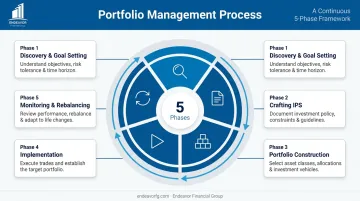
The 5 Key Phases of the Portfolio Management Process
Whether you manage your own investments or work with a professional, the process follows a foundational five-phase cycle. At Endeavor Financial Group, we use this structured approach to ensure every decision is intentional and aligned with your objectives.
Phase 1: Discovery and Goal Setting
The process begins with a deep assessment of your current financial situation, including your income, assets, and liabilities. This phase is about asking the big questions:
- What are my specific, measurable financial goals (e.g., retiring at 65 with $100,000 in annual income)?
- What is my investment time horizon?
- What is my risk tolerance—my ability and willingness to handle market ups and downs?
Phase 2: Crafting the Investment Policy Statement (IPS)
The IPS is a formal document that acts as your portfolio’s constitution. It outlines your goals, risk tolerance, and, most importantly, your target asset allocation.
Asset allocation is the strategic decision of how to divide your portfolio among different asset classes like stocks, bonds, and cash. It's the primary driver of your portfolio's risk and return profile. In fact, research consistently shows that asset allocation decisions account for more than 90% of a portfolio's return fluctuations over time.
Phase 3: Portfolio Construction
With the IPS as a guide, the next step is to select specific investments within each asset class. This could involve choosing individual stocks, bonds, ETFs, or mutual funds that align with your strategy.
A key principle here is diversification. By spreading investments across various sectors, industries, and geographies, you can reduce the risk of having too much of your portfolio tied to the success of a single asset.
Phase 4: Implementation and Execution
This is the practical step of putting the plan into action. It involves purchasing the selected securities in the right proportions to build the portfolio as designed in the construction phase.
Phase 5: Ongoing Monitoring and Rebalancing
Portfolio management is not a “set it and forget it” activity. This final, continuous phase involves two key activities:
- Monitoring: Regularly reviewing your portfolio's performance against relevant benchmarks and checking if it's still on track to meet your goals.
- Rebalancing: Over time, market movements cause your asset allocation to drift. For instance, a strong year for stocks might push your stock allocation from 60% to 70%. Rebalancing involves selling some outperforming assets and buying underperforming ones to return to your original target.
This discipline is primarily about controlling risk, not chasing higher returns—a principle confirmed by extensive research from firms like Vanguard.
Key Types of Portfolio Management Explained
Understanding the different approaches to managing a portfolio helps you decide what level of involvement and control you want to have. The main distinctions come down to two pairs of choices.
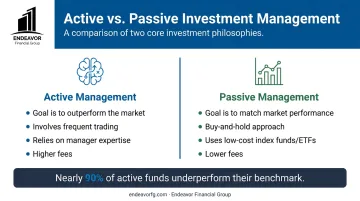
Active vs. Passive Management
- Active Management: This is a hands-on strategy where a manager actively buys and sells securities with the goal of outperforming a market benchmark, like the S&P 500. It relies on the manager's research and expertise to find undervalued assets or anticipate market trends. This approach typically involves higher fees.
- Passive Management: This is a hands-off strategy that simply aims to replicate the performance of a market index. This is usually done by investing in low-cost index funds or ETFs that hold the same securities as the index.
While active management sounds appealing, historical data shows it's incredibly difficult to consistently beat the market. According to S&P's SPIVA data, nearly 90% of U.S. large-cap funds underperformed the S&P 500 over a 15-year period.
This performance gap, combined with the higher fees associated with active strategies, has made passive investing an effective and popular choice for many long-term investors.
Discretionary vs. Non-Discretionary Management
- Discretionary: In this model, you give the portfolio manager full authority to make and execute investment decisions on your behalf without needing your approval for each trade. This is ideal for investors who want to delegate the day-to-day management completely to a trusted professional.
- Non-Discretionary: Here, the manager provides recommendations and advice, but you, the investor, must approve every transaction before it's executed. This approach is for those who want professional guidance but wish to retain final control over their portfolio.
Essential Portfolio Management Strategies for Your Goals
Once you've chosen a management type, a specific strategy is applied based on your risk tolerance and goals. Most strategies fall along a spectrum from conservative to aggressive.
- Aggressive Growth: Aims for maximum capital appreciation with a high allocation to stocks (80%+). This is best for investors with a high risk tolerance and a long time horizon.
- Capital Preservation (Conservative): Prioritizes protecting principal over generating high returns by using lower-risk assets like government bonds. It's ideal for risk-averse investors or those near retirement.
- Balanced Growth & Income: Seeks a blend of growth and income by balancing stocks and bonds (e.g., a 60/40 split) to achieve reasonable growth with less volatility.
The Benefits of Working with a Professional Portfolio Manager
For busy executives, business owners, and pre-retirees, managing a portfolio can feel like a second full-time job. Working with a professional offers several key advantages.
The first is expertise and research. Professionals have access to in-depth research, sophisticated tools, and the experience needed to navigate complex markets and make informed decisions.
Perhaps the most significant benefit is emotional discipline. A financial advisor acts as a behavioral coach, providing a buffer against making impulsive decisions during market downturns or bubbles. Vanguard's Advisor's Alpha framework estimates that this coaching alone can add significant value to an investor's net returns, helping you stick to your long-term plan when it matters most.
Finally, a professional provides a comprehensive and structured approach. At Endeavor Financial Group, for example, we utilize a clear, four-step process to ensure every client has a roadmap tailored to their unique financial situation:
- Introductory Meeting: We identify your goals, priorities, and potential obstacles to ensure our partnership is the right fit.
- Exploration & Preliminary Planning: We take a deep dive into your finances, sketching a preliminary plan that we refine together through open communication.
- Detailed Planning: We deliver a clear roadmap and build a solid, tax-efficient portfolio designed to achieve your long-term goals.
- Ongoing Support & Advice: We adapt your plan as your life and goals evolve, providing continuous support for every new chapter.
This structured process ensures that your portfolio is always aligned with your life, giving you the clarity and confidence to move forward.
Frequently Asked Questions
What do portfolio management services do?
These services manage an investor's assets by creating a custom strategy and making ongoing adjustments. The goal is to meet specific financial objectives while aligning with the investor's risk tolerance.
Is it good to invest in portfolio management services?
Yes, it is beneficial for those who lack the time or expertise to manage investments on their own. A professional service provides a disciplined, structured approach to building and protecting wealth.
What are the 4 types of portfolio management?
The four main types are: Active (beating the market), Passive (tracking the market), Discretionary (manager has full control), and Non-Discretionary (investor approves all trades).