Strategic asset management is the bridge that converts your business success into lasting personal wealth and financial independence. It’s about building a financial life that can thrive with—or without—your company.
This article outlines the top asset management strategies designed for the unique financial DNA of an entrepreneur. We'll explore how to protect what you've built, systematically grow wealth outside your business, and prepare for your ultimate financial milestone: your exit.
Key Takeaways
- Prioritize risk management and cash reserves to protect business and personal assets.
- Build wealth outside your business to reduce concentration risk and create new income streams.
- Use retirement accounts like SEP IRAs and Solo 401(k)s to lower taxes and accelerate growth.
- Integrate exit planning from day one to maximize your business's long-term value.
- Develop a comprehensive financial plan that makes all your financial strategies work together.
Why Asset Management for Business Owners is a Different Ballgame
Standard financial advice often misses the mark for entrepreneurs. The "save 15% of your steady paycheck in a 401(k)" model simply doesn't apply when your income fluctuates and your personal and business finances are deeply intertwined.
The core challenge is concentration risk. Data from the Exit Planning Institute shows that 80-90% of a business owner's wealth is often tied up in their company. This high-stakes environment means a single market shift, industry disruption, or personal event could jeopardize an entire net worth.
For an entrepreneur, financial planning isn't about a predictable salary. It's about:
- Managing inconsistent income and preparing for large, infrequent capital events.
- Navigating entangled finances, since personal guarantees often blur the lines of liability.
- Creating a clear exit strategy, as the business is likely your largest retirement asset.

Top 4 Asset Management Strategies for Business Owners
These four strategies are essential for building a resilient financial future that extends beyond the day-to-day operations of your business.
Strategy 1: Fortify Your Foundation with Risk and Cash Management
Before you can grow wealth, you must protect it. The first step is creating a firewall between your business and personal liabilities. This isn't just a legal distinction; it's a financial one.
Start with essential insurance protections to safeguard against catastrophic events:
- Personal Umbrella Insurance: This provides an extra layer of liability coverage above and beyond your home and auto policies, protecting your personal assets from lawsuits that could arise from either business or personal activities.
- Key Person Insurance: This is a life insurance policy the business takes out on a crucial owner or employee. If that person passes away unexpectedly, the payout provides the company with the liquidity needed to recruit a replacement, pay off debt, and ensure business continuity.
Next, focus on strategic cash management. It’s tempting to reinvest every spare dollar back into the business, but maintaining a robust cash reserve—a "war chest"—is critical. This provides the stability to make strategic, not desperate, decisions during a downturn.
Instead of letting cash sit idle, consider placing reserves in instruments that balance safety with a modest return, such as high-yield savings accounts or short-term fixed-income investments.
Strategy 2: Systematically Diversify to Build Wealth Outside Your Business
Diversification is the most powerful tool for de-risking your personal balance sheet. The goal is simple: to create a financial future that isn't entirely dependent on your company's success. This requires a disciplined, ongoing process of allocating a portion of business profits to build wealth elsewhere.
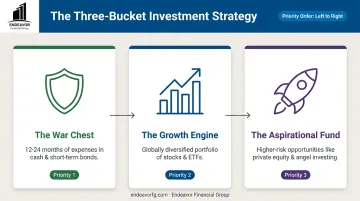
A proven method is the "Three-Bucket" approach to investing personal capital:
- The War Chest: This is your foundation of safety and liquidity. It should hold 12-24 months of personal living expenses in highly stable assets like cash, money market funds, and high-quality short-term bonds. This bucket gives you peace of mind and prevents you from ever having to sell growth assets at the wrong time.
- The Growth Engine: Once your war chest is full, you can focus on long-term growth. This bucket contains a globally diversified portfolio of public assets like stocks, ETFs, and REITs. The goal here is compound growth, completely independent of your business's industry.
- The Aspirational Fund: This bucket is for higher-risk, higher-reward investments you can explore once the first two are secure. This might include private equity, angel investing, or direct real estate deals. These are opportunities, not necessities.
Strategy 3: Leverage Tax-Advantaged Retirement & Savings Vehicles
For business owners, tax planning is a powerful lever for wealth creation. You have access to "supercharged" retirement plans that allow for much higher contribution limits than standard employee accounts.
These are the primary options to consider:
- SEP IRA: A Simplified Employee Pension (SEP) IRA is straightforward to set up and allows you to contribute up to 25% of your compensation, with a maximum of $69,000 for 2024. It's an excellent choice for sole proprietors or businesses with few employees.
- Solo 401(k): If you're self-employed with no employees (other than a spouse), a Solo 401(k) is often the best choice. It allows you to contribute as both the "employee" (up to $23,000 in 2024) and the "employer" (up to 25% of compensation), with the same total limit as a SEP IRA. Many plans also allow for Roth contributions and loans.
- Cash Balance Plans: For highly profitable businesses, these plans offer the ability to make very large, tax-deductible contributions. They are technically a type of defined benefit plan and are more complex, but they can be a powerful tool for owners looking to maximize retirement savings in their peak earning years.
The dual benefit of these plans is powerful: you reduce your taxable income today while building a tax-deferred (or tax-free, with Roth options) nest egg that is completely separate from your business.
Strategy 4: Prepare for Your Ultimate Liquidity Event with Succession Planning
Your business exit will likely be the single largest financial event of your life. Maximizing its value doesn't happen overnight; it requires years of intentional preparation. An effective exit strategy involves building a business that is valuable and transferrable without your daily involvement.
Buyers and investors look for specific value drivers that reduce their risk and signal future stability. Long before you plan to sell, focus on strengthening these areas:
- A strong management team that can run the business independently.
- Recurring revenue streams that create predictable cash flow.
- Clean, organized financial records, ideally reviewed by a third-party CPA.
- A diversified customer base to avoid over-reliance on a few key clients.
Thinking about your exit path—whether it's a sale to a third party, a family succession, or a management buyout—is a critical part of your long-term asset management. The path you choose will influence how you structure your finances and prepare for managing the proceeds.
Navigating these strategies—from risk management to exit planning—requires careful coordination. Working with a financial advisor can help ensure each decision aligns with your long-term personal and business goals.
How to Build Your Integrated Wealth Blueprint
Effective asset management strategies are not standalone options; they are interlocking pieces of a single, cohesive financial blueprint that aligns your business decisions with your personal goals. An effective blueprint is dynamic, designed to be reviewed and adjusted as your business and life evolve.
Building this blueprint requires a structured process. At Endeavor Financial Group, our five-step framework ensures every component of your financial life works in concert.
- Define Your Vision: The process begins by identifying your personal and financial goals, priorities, and values to understand what you want to achieve beyond the business.
- Analyze Your Financials: Next is a comprehensive review of your complete financial picture—analyzing cash flow, assets, liabilities, and risk exposures to build a strategic foundation.
- Create an Actionable Roadmap: We then develop a clear plan with specific recommendations for risk management, diversification, tax efficiency, and your eventual business exit.
- Coordinate Implementation: Your plan is put into action by coordinating with all your professional partners, including attorneys and accountants, to ensure proper execution.
- Monitor and Adapt: A financial plan isn't static. It requires continuous support and regular reviews to make adjustments as your business and life circumstances change.
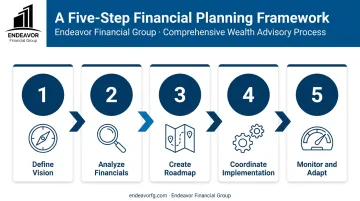
This integrated approach transforms your finances from a series of disconnected accounts into a coordinated system designed for growth, protection, and to secure your legacy.
Conclusion: Secure Your Legacy with a Strategic Partner
Transforming business success into lasting, multi-generational wealth requires a crucial mindset shift. You must move from focusing solely on growing your company to strategically building and protecting your personal financial world.
This journey is complex. A financial planning partner who understands the unique challenges of business owners provides the clarity and confidence you need to secure your future.
Don't leave your legacy to chance. Contact Endeavor Financial Group today to build a personalized strategy that protects your legacy.
Frequently Asked Questions
What are the 5 P's of asset management?
The 5 P's are a framework used to evaluate an investment manager or strategy: People (the team's experience), Philosophy (the core investment beliefs), Process (how the philosophy is implemented), Portfolio (the resulting holdings), and Performance (the historical results and how they were achieved).
How do I balance reinvesting in my business versus diversifying outside of it?
It’s not an all-or-nothing choice. A sound strategy involves creating a disciplined plan to allocate a percentage of profits toward external diversification on a consistent basis. This ensures your personal wealth grows alongside the business, preventing over-concentration.
What's the difference between asset management and wealth management for a business owner?
Asset management focuses only on your investment portfolio. In contrast, comprehensive wealth management takes a holistic approach, integrating investments with tax, estate, risk, and business succession planning to align your entire financial picture.
When is the right time for a business owner to hire a financial advisor?
The right time isn't about reaching a specific net worth; it's about complexity. When your business creates financial questions you can't answer—like handling profits, planning an exit, or protecting assets—it's time for professional guidance.
Can these asset management strategies also help with my business exit plan?
Absolutely. These strategies are crucial for a successful exit. Diversifying wealth beforehand reduces pressure to sell at a specific time, while proper tax and estate planning helps you keep more proceeds from the sale.