
Standard estate planning is often insufficient for protecting significant wealth. To truly preserve what you’ve built, you need to go beyond the basics. This article explores advanced, yet accessible, tax planning strategies that can help minimize your estate’s tax liabilities and ensure your wealth is transferred according to your wishes, not a tax code.
TLDR: Advanced Estate Tax Planning
- Use legal tools like trusts and strategic gifting to minimize your taxable estate.
- Leverage advanced trusts like SLATs, GRATs, and ILITs to protect assets.
- Act before the federal estate tax exemption drops significantly in 2026.
- Consult an advisor to tailor these complex strategies to your family's specific goals.
Why Advanced Tax Planning for Your Estate is Critical Now
Timing is a crucial factor in estate planning. A major tax law change is on the horizon, creating a window of opportunity for high-net-worth families to act.
The 2026 Estate Tax "Sunset" Creates Urgency
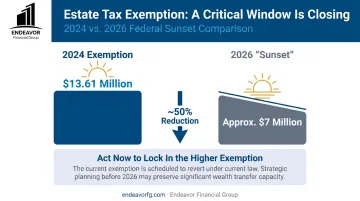
Under current law, the federal estate tax exemption is historically high. In 2024, an individual can pass on $13.61 million to their heirs without federal estate or gift taxes, and a married couple can shield double that amount.
However, this favorable law is temporary. On January 1, 2026, the exemption amount is scheduled to be cut by roughly half. An estate that is fully exempt from federal taxes today could suddenly face a substantial tax bill on several million dollars.
Planning actions taken now can lock in the benefits of the current high exemption. By transferring assets using today's exemption amounts, you can permanently remove them from your taxable estate, regardless of what the exemption level is when you pass away.
Beyond Federal Taxes: State-Level Considerations
While the federal exemption gets most of the attention, state-level taxes are also a critical factor. According to the Tax Foundation, as of 2025, 12 states and the District of Columbia impose their own estate tax, and five states have an inheritance tax (paid by the beneficiary).
Even though our firm is based in Indiana, which has no estate or inheritance tax, we work with clients who have property or family in other states. This geographic diversification makes a comprehensive plan essential to navigate varying state laws and avoid unexpected tax burdens.
Protecting Your Legacy from More Than Just Taxes
While tax reduction is a primary driver, advanced estate planning offers other powerful benefits:
- Asset Protection: Shield your family’s inheritance from creditors, lawsuits, and potential divorces.
- Distribution Control: Dictate how and when your wealth is distributed, ensuring beneficiaries are prepared to manage it responsibly.
- Generational Planning: Structure your estate to support your family’s financial well-being for multiple generations.
Foundational Strategies: The Power of Strategic Gifting
One of the most straightforward ways to reduce the size of your taxable estate is to give some of it away during your lifetime. Strategic gifting provides an immediate benefit to your loved ones while systematically lowering your future tax exposure.
Leveraging the Annual Gift Tax Exclusion
The IRS allows you to give a certain amount to any individual each year without it counting against your lifetime exemption. For 2024, the annual gift tax exclusion is $18,000 per recipient. This is a "use it or lose it" benefit that resets every year.
This strategy becomes incredibly powerful for families. For example:
- A married couple with three children can gift each child $18,000 from each parent.
- That's $36,000 per child, for a total of $108,000 transferred completely tax-free in a single year.
- If they also have three grandchildren, that amount doubles to $216,000 per year.
Over a decade, this simple strategy can move millions of dollars out of a taxable estate without any tax consequences or complex paperwork.
Charitable Giving and Donor-Advised Funds (DAFs)
Beyond direct gifts to family, charitable giving is another effective way to reduce a taxable estate while supporting causes you care about.
A Donor-Advised Fund (DAF) is a popular tool for this. It functions like a charitable investment account: you contribute assets (cash, stocks, etc.), receive an immediate tax deduction, and then recommend grants from the fund to your favorite charities over time.
Advanced Trust-Based Strategies to Preserve Your Legacy
For more significant asset protection and tax savings, irrevocable trusts are the cornerstone of advanced estate planning. When you transfer assets to an irrevocable trust, you legally remove them from your ownership and, consequently, from your taxable estate.
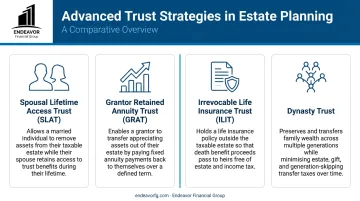
Spousal Lifetime Access Trust (SLAT)
A Spousal Lifetime Access Trust (SLAT) is a popular strategy for married couples. It allows one spouse (the donor) to make a significant gift into a trust for the benefit of the other spouse (the beneficiary), removing the assets from their combined estates.
The beneficiary spouse can still receive distributions from the trust. This allows you to use your gift tax exemption and reduce your estate while maintaining indirect access to the funds if needed.
Grantor Retained Annuity Trust (GRAT)
A Grantor Retained Annuity Trust (GRAT) is ideal for transferring the appreciation of high-growth assets—like stock in a fast-growing company—to heirs with minimal tax impact. You transfer assets into the trust and, in return, receive a fixed annual payment (an annuity) for a set term.
Any growth in the assets above a specific IRS interest rate passes to the beneficiaries free of estate and gift tax. It essentially "freezes" the asset's current value for tax purposes, allowing all future appreciation to transfer to the next generation.
Irrevocable Life Insurance Trust (ILIT)
Contrary to popular belief, a life insurance death benefit can be included in your taxable estate. Under U.S. Code § 2042, proceeds are generally taxable if the deceased person held "incidents of ownership" in the policy, such as the right to change beneficiaries.
An Irrevocable Life Insurance Trust (ILIT) is an irrevocable trust created specifically to own your life insurance policy. You make cash gifts to the trust, and the trustee uses that cash to pay the policy premiums.
Since the trust owns the policy, not you, the death benefit is paid to your beneficiaries completely free from estate taxes. This also provides the estate with immediate cash to pay any remaining taxes without forcing heirs to sell assets like a family business or home.
Dynasty Trust
A Dynasty Trust is a long-term trust designed to pass wealth through multiple generations while minimizing or avoiding estate and Generation-Skipping Transfer (GST) taxes.
By properly structuring the trust and allocating your GST tax exemption, you can create a legacy that supports your children, grandchildren, and even great-grandchildren without the value being eroded by transfer taxes at each step.
Specialized Strategies for Business Owners and Real Estate
Assets like a family business or a real estate portfolio require specialized planning. Their value isn't as simple as a stock portfolio, and transferring them involves unique challenges.
Family Limited Partnerships (FLPs) and LLCs
An FLP or a family LLC is an entity created to hold family assets, consolidating them under a single structure. Senior family members typically act as general partners (maintaining control), while children or grandchildren are limited partners.
You can then gift shares of the partnership to family members over time. For tax purposes, these minority-stake, non-controlling shares often receive a valuation discount due to a lack of marketability and control.
This allows you to transfer the underlying assets to your heirs at a reduced gift tax value, passing on more wealth while using less of your lifetime exemption.
Qualified Personal Residence Trust (QPRT)
A QPRT is a specialized trust that allows you to transfer your primary residence or a vacation home out of your estate at a significant discount. You transfer the title of the home to the trust but retain the right to live in it for a specified number of years. The value of the gift for tax purposes is calculated based on the home's current value, your age, the length of the term, and interest rates. This results in a gift tax value far below the home's market price.
At the end of the term, the home belongs to your beneficiaries, and all its future appreciation is excluded from your estate.
Putting It All Together: Your Strategic Plan with Endeavor Financial Group
The strategies discussed here are powerful, but they are not "off-the-shelf" solutions. They are complex legal and financial instruments that must be carefully designed and integrated into a cohesive plan. A misstep in one area can undermine the effectiveness of another.
This is where Endeavor Financial Group provides critical value. As your financial quarterback, we take a holistic perspective to ensure your estate plan works in harmony with your investments, retirement income, and business succession goals.
Our team approach means we coordinate directly with your attorneys and tax professionals. This collaboration ensures the legal documents and your financial realities are perfectly aligned.
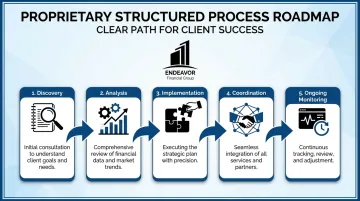
Our five-step structured process provides a clear roadmap, moving from discovery and analysis to implementation and ongoing monitoring. This ensures every decision supports your overall objectives.
As a fee-only fiduciary, our advice is driven by your best interests, not commissions. We provide the unbiased guidance needed to navigate these complex decisions, giving you financial confidence and peace of mind.
Frequently Asked Questions
What is the difference between estate tax and inheritance tax?
Estate tax is paid by the deceased person's estate before any assets are distributed. Inheritance tax is paid by the beneficiaries who receive the assets and is only imposed by a handful of states.
How much can you gift to a family member tax-free in 2024?
In 2024, you can give up to $18,000 to any individual without filing a gift tax return or using your lifetime exemption. This amount is per person, per recipient, and resets annually.
What is the current federal estate tax exemption?
For 2024, the federal estate tax exemption is $13.61 million for an individual and $27.22 million for a married couple. This high exemption amount is scheduled to be significantly reduced in 2026.
Are life insurance proceeds included in a taxable estate?
Yes, proceeds are typically included if you own the policy. However, placing the policy inside a properly structured Irrevocable Life Insurance Trust (ILIT) can exclude them from your taxable estate.
What is the main purpose of an irrevocable trust in estate planning?
Its main purpose is to remove assets from your estate, which reduces or eliminates estate taxes. An irrevocable trust also provides significant asset protection and allows you to control how assets are eventually distributed.
Do I need advanced estate planning if my assets are below the federal exemption?
Yes, because the current high federal exemption is scheduled to be cut significantly in 2026. Proactive planning also helps you navigate state-level estate taxes and protect assets from potential creditors.