
This guide is here to change that. We'll demystify business transition planning, breaking it down into a clear, phased approach. By aligning your exit with your personal financial goals, you can navigate this complex process with confidence and control.
TL;DR: Your Business Transition Checklist
- Start with Your Why: Before anything else, define your personal, financial, and legacy goals for life after the business.
- Know Your Options: The three main exit paths are selling to a third party, transitioning to family, or selling to employees. Each has distinct pros and cons.
- Prepare for Max Value: Start 3-5 years early by getting a professional valuation, cleaning up your financials, and reducing the business's dependency on you.
- Build Your A-Team: A successful transition requires a team of experts—a CFP®, CPA, and attorney—working in concert.
- Manage the Windfall: Your work isn't done at the closing table. A solid wealth management plan is crucial for turning sale proceeds into lasting financial security.
Why Proactive Business Transition Planning is Non-Negotiable
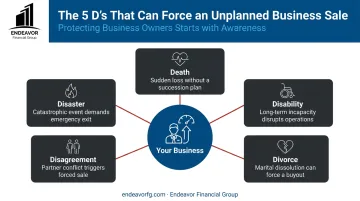
Life is unpredictable. For a business owner, unexpected events can force a sale under the worst possible circumstances. Financial planners often refer to the "5 D's" as major triggers that can derail an owner's plans:
- Death
- Disability
- Divorce
- Disagreement (with a partner)
- Disaster
When one of these events occurs without a plan in place, the result is often a rushed, chaotic, and undervalued sale. You lose control over the timing, the price, and the future of the company you built.
A proactive plan flips the script, putting you in the driver’s seat. Yet, most business owners haven’t taken this critical step. According to PwC's 2021 Family Business Survey, only 34% of North American family businesses have a robust, documented succession plan.
This lack of preparation is risky. The Exit Planning Institute reports that 50% of all business exits are involuntary—meaning half of all owners are forced to sell before they’re ready.
Without a plan, you're not just risking your business's survival; you're risking your own retirement.
Phase 1: Defining Your Personal and Business Exit Goals
The first phase of any successful transition plan isn't about business valuation—it's about introspection. Your business exit must serve your life goals, not the other way around. Before you talk to a single buyer or advisor, you need to answer some fundamental questions.
Grab a notebook and write down your honest answers to the following:
- What does life after the business look like for you? Picture your ideal future: full retirement, a new venture, or part-time consulting. Be specific.
- What are your financial needs? Calculate the amount of capital you'll need from the sale to fund your desired lifestyle indefinitely. This number is your most important benchmark.
- What is your ideal timeline? Do you want to be out in three years, five years, or are you planning a decade-long transition? This timeline dictates the entire preparation strategy.
- How important is your business legacy? Do you want the company name to live on? Is it important that the culture you built is preserved? Who do you envision taking over?
These written goals become the guiding principles for every decision you make moving forward. They provide clarity and purpose, ensuring your transition strategy stays aligned with your personal definition of success.
Phase 2: Exploring Your Three Primary Exit Paths
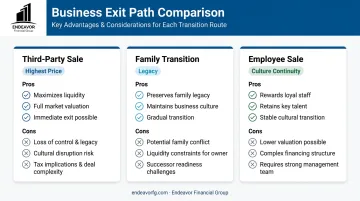
Once you know what you want, you can start exploring how to get there. Most business exits fall into one of three main categories.
Path 1: Selling to a Third Party (External Sale)
This path is ideal for owners focused on maximizing their financial return. Buyers typically fall into two categories:
- Strategic Buyers: Competitors, suppliers, or other companies in your industry who can gain a strategic advantage by acquiring your business (e.g., market share, technology, customer lists).
- Financial Buyers: Private equity firms or investors looking for a solid business with strong cash flow and growth potential that can deliver a return on their investment.
Pros:
- Highest Potential Sales Price: Strategic buyers, in particular, may pay a premium.
- A Clean Break: This path often allows for a complete exit from the business.
- New Resources: The buyer can inject new capital and expertise to grow the company.
Cons:
- Loss of Legacy: The new owner will likely change the company culture and may not keep the name.
- Demanding Due Diligence: Expect a rigorous and lengthy process of financial and operational scrutiny.
- Less Control: You have little say in the business's future after the sale is complete.
Path 2: Transitioning to Family Members
For many owners, keeping the business in the family is the ultimate goal. This path prioritizes legacy and continuity over pure financial gain. You can structure a family transition as a sale, a gift, or a combination of both.
Pros:
- Preservation of Legacy: The family name and company culture are more likely to continue.
- Gradual Transition: You can step back over time, mentoring the next generation.
- Rewarding Family: It provides a unique opportunity for your children or relatives.
Cons:
- High Potential for Conflict: Mixing business and family emotions is incredibly difficult and can lead to lasting disputes.
- Successor Readiness: The next generation may lack the skills, experience, or even the desire to run the business. Objectivity is crucial but hard to maintain.
- Lower Survival Rate: The succession odds are challenging. According to research compiled by Cornell University, only about 40% of family-owned businesses transition to the second generation, and just 13% make it to the third.
Path 3: Selling to Key Employees or Managers
This option rewards the people who helped you build the company. It can take the form of a Management Buyout (MBO), where the leadership team buys the company, or an Employee Stock Ownership Plan (ESOP), a formal retirement plan that buys shares on behalf of employees.
Pros:
- Continuity of Culture: Leadership transitions to the people who already embody the company's values.
- Rewards Loyalty: It's a powerful way to thank and empower your dedicated team.
- Smoother Operations: The transition is often seamless, as the new owners already know the business inside and out.
- Tax Advantages: ESOPs, in particular, can offer significant tax benefits to both the selling owner and the company.
Cons:
- Funding Challenges: Employees often lack the capital for a buyout, frequently requiring the owner to provide financing (a seller's note).
- Potentially Lower Price: The sale price may be less than what a third-party strategic buyer would offer.
- Leadership Development: You may need to invest heavily in training your managers to think and act like owners.
Each path has unique financial, tax, and legacy implications. Working with a financial advisor specializing in business succession helps you objectively weigh these pros and cons, ensuring your exit strategy aligns with your long-term personal and financial goals.
Phase 3: Preparing Your Business for a High-Value Transition
To maximize your business's value during an exit, preparation is key. This process should ideally begin 3 to 5 years before your target exit date. Your goal is to make your business as attractive, stable, and "turn-key" as possible.
Get a Professional Business Valuation
You can't plan your future without knowing what your biggest asset is worth today. A formal business valuation provides a realistic baseline, helps set an achievable sale price, and identifies key areas where you can increase value.
Valuators use several methods—including asset-based, market-based, and income-based approaches—to arrive at a defensible number. A financial advisor can help coordinate this process and integrate the findings into your broader transition plan.
Strengthen Your Financials and Operations
A potential buyer will put your business under a microscope. Now is the time to get your house in order.
- Clean up your financial records: Work with your accountant to ensure your books are pristine and professionally prepared.
- Document everything: Create Standard Operating Procedures (SOPs) for every key function in the business. This proves the company can run without you.
- Diversify your customer base: If one client makes up more than 15-20% of your revenue, it's a major red flag for buyers. Work to reduce that dependency.
- Lock in key contracts: Secure long-term agreements with your most important customers and suppliers to demonstrate stability.
Reduce Owner Dependency
A business that cannot run without its owner is a job, not a sellable asset. This is one of the most critical value-drivers to address.
Start delegating key responsibilities to a trusted management team and empower them to handle daily operations independently. The more your business runs on its systems and team—not on you—the more valuable it becomes to a buyer.
Phase 4: Assembling Your Expert Team & Executing the Plan
Phase 4: Assembling Your Expert Team & Executing the Plan
A business transition is not a DIY project. Trying to manage it alone can lead to costly mistakes, which is why a successful exit requires a dedicated team of professionals.
- Certified Financial Planner (CFP®): The "quarterback" who aligns the entire transition with your personal financial goals.
- CPA/Accountant: Manages the financial cleanup, tax planning, and accurate reporting needed for due diligence.
- Attorney: Handles all legal aspects, from structuring the deal to drafting purchase agreements and ensuring compliance.
- Business Broker/M&A Advisor: Manages the process of finding and vetting buyers for a third-party sale.
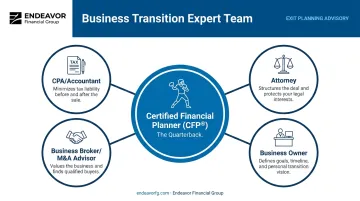
Coordinating these experts is crucial. At Endeavor Financial Group, our CFP® professionals act as the quarterback for your team.
We don't replace your CPA or attorney; we work alongside them to ensure all professional advice aligns with your ultimate financial objectives in one cohesive plan.
Our structured five-step process—from discovery to ongoing monitoring—brings clarity to this complex phase. We help you execute a transition plan that is actively managed and adapts as your life and goals evolve.
Life After the Handover: Securing Your Financial Future
Once the deal is closed and the funds are in your account, your work isn't over. This large sum of money isn't just a windfall; it's the capital that must support your lifestyle for the rest of your life.
This is where post-sale wealth management becomes critical. You'll need a clear strategy for:
- Investment Management: Building a diversified portfolio designed to generate reliable income and preserve capital.
- Tax Management: Structuring your investments and withdrawals in the most tax-efficient way possible to minimize your liability.
- Estate Planning: Ensuring your wealth is transferred to the next generation or charitable causes according to your wishes.
The relationship with your financial advisor is more important than ever at this stage. Having a trusted partner who understands your journey from business owner to retiree is key to turning the proceeds of your life's work into lasting financial security. The team at Endeavor Financial Group specializes in guiding entrepreneurs through this exact transition.
Frequently Asked Questions
What is business transition planning?
It's the process of creating and executing a strategy for transferring your business's ownership and management. A good plan ensures the company's continued success while allowing you to exit on your own terms, both financially and personally.
What common frameworks (like the 4 P's and 5 D's) are used in business transition planning?
Frameworks like the "5 D's" (Death, Disability, Divorce, Disagreement, Disaster) identify common triggers for an unplanned exit. Others, such as the "4 P's" (People, Purpose, Process, Performance), help structure the strategic plan itself.
How long does a business transition typically take?
A well-planned transition is a multi-year process, ideally starting 5-10 years before your desired exit. The actual sale process itself, from preparation to closing, can take 5 to 12 months on average.
What is the first step I should take to start planning my business transition?
The first and most important step is personal goal-setting. Before you even think about valuation, define what you want your life to look like after the business and determine the financial resources you'll need to make that vision a reality.
How does a business valuation work and why is it important?
A valuation assesses your business's economic worth using various methods (income, market, asset-based). It's critical for setting a realistic price, providing a benchmark for negotiations, and helping a potential buyer secure financing for the deal.